Index
Macro Update
by Dean Orrico, President & CEO and Robert Lauzon, CIO
The midterms settled one question for markets but reopened others, and the selling that followed turned October’s rotation into a broader retreat in early November. Positioning is now much lighter, yet with most of the year behind us the question for investors is whether the bottom is in, or whether waiting for confirmation will leave them on the sidelines.
Equity markets navigated major central bank announcements and a raft of high-profile earnings reports in the last week of October. During the month the S&P 500 lost just 0.9% and the MSCI World Index was down 0.8%, while the S&P/TSX outperformed, advancing 1.2%. Year-to-date, all three indices remain up between 11% and 15%. Beneath the surface, 9 of 11 US sectors ended October in positive territory while earnings misses at Intel and Google captured the headlines and drove the S&P 500 and Nasdaq weakness at month-end. The hyperscaler-related sectors, Communication Services (-15.2%) and Technology (-6.8%), were the only ones to post negative returns, as the relentless rise in capex weighed on free cash flow and sentiment. In Canada, 10 of 11 sectors finished the month in the green, with only Materials (-13.1%) declining. We believe the market may be transitioning from a narrow, AI-led regime toward broader participation.
Even as temperatures cooled this fall, inflation has stayed a little too warm, prompting the Bank of Canada to raise interest rates by 25 bps. The Federal Reserve held rates at its October 28 meeting but hinted that a December hike is likely. Global central banks are concerned that higher oil prices, with WTI rising $10 during October to above $103, will spread inflation to services and goods prices. Oil has since retreated to below $90 on hopes of Iran de-escalation. A potentially slower build-out of data centres and AI capex could also ease inflation in the months ahead, and the market could quickly recalibrate its rate-hike expectations. Indeed, the US 10-year government yield appears to have peaked in early October and is now trading towards 5%. More benign inflation, lower oil prices and a less hawkish rate cycle would all support equities.
The US economy has digested higher oil prices for most of this year. In the Federal Reserve’s own words, the economy is strong: it expanded at a 3.4% annualized rate in the third quarter, the largest gain in a year and above expectations. The equity market has been underpinned by this economic strength and corresponding robust earnings. As at time of writing, the S&P 500 companies that have reported their Q3 2026 results have beat estimates by 5.6% on aggregate with over three quarters of companies topping projections to date. Forecast operating margins have expanded by more than 2% which should support 2027 earnings estimates if realized. While earnings growth in 2027 will likely slow from the torrid pace of 2026, the market has anticipated the slowdown with a contraction in multiples. Since the bear market rate hiking cycle ended in October 2022, the S&P 500 index has returned approximately 97%, forward earnings are up 65%, while forward P/E has only expanded by 20%. The rise in the S&P YTD has been driven almost entirely by earnings, and we feel that the risk/reward looks attractive at this juncture.
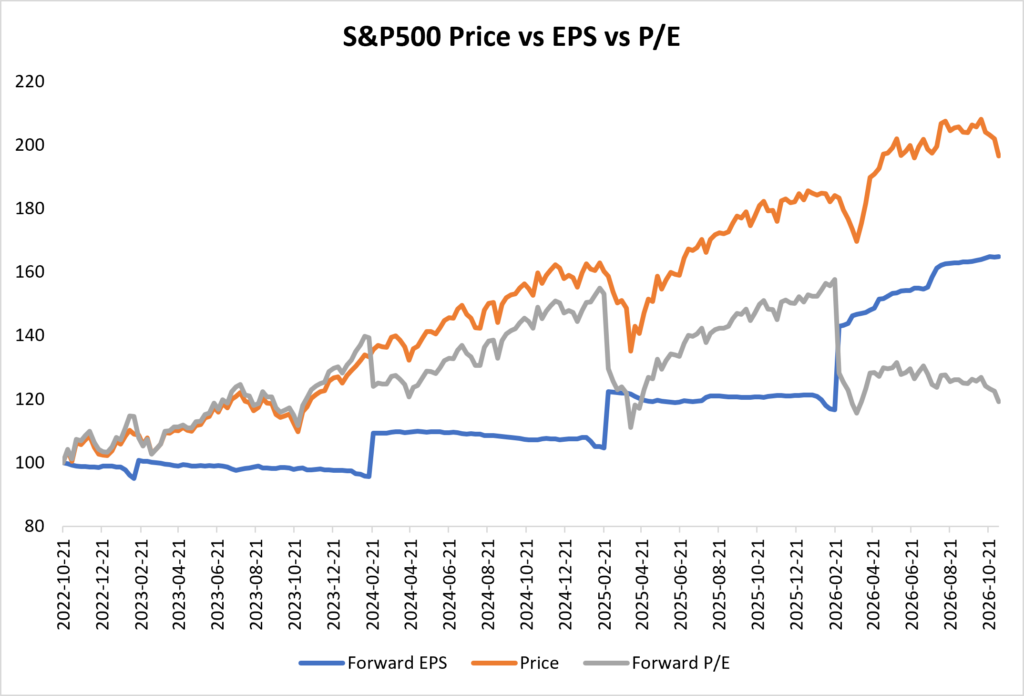
Source: Middlefield Ltd, Bloomberg LP. As of November 9, 2026
The US midterm election took place on November 3, and the Democrats decisively won control of the House and Senate. As we wrote last month, equity market returns are generally positive after elections. Going back to 1970, the average one-year forward S&P 500 price return from Election Day with a Republican president and a Democratic Congress is 10%. While it is still early days, slower data centre build-out could be a likely policy outcome for 2027, potentially resulting in a more measured AI capex cycle. Over the last couple of years, AI capex has been a big contributor to GDP growth but also to inflation, as demand for infrastructure has driven up prices for chips, computers and construction labour. A more measured pace may put a damper on the US economy, but it could also take pressure off inflation and rates.
Back at home, on November 5 the Liberal government released Budget 2026: Masters of Our Destiny. The budget outlines $142 billion in new spending, tax breaks over five years and incentivizes business investment in Canada primarily through a substantial tax write-off program and expanded capital gains exemptions. For example, it lowers the marginal effective tax rate on new business investment from 13% to 6.4% and introduces a $15 million lifetime capital gains exemption on eligible investments in Canadian-owned small businesses, farms and fishing properties. With an investment-led, pro-growth federal budget, the removal of Alberta’s referendum uncertainty, and a newly elected BC government that campaigned on resource-sector development, faster project approvals and tax relief for businesses and citizens, we believe GDP growth will be positively impacted over the medium term. Despite lower exposure to AI companies, the TSX has outperformed the S&P 500 over the last one year, three years and year-to-date in CAD.
Real Estate
Middlefield Fund Tickers & Codes: MREL / MID 600 / RS / RS.PR.A
by Dean Orrico, President & CEO
The Middlefield Real Estate Dividend strategies slightly outperformed TSX Capped REIT index for the month and remain ahead of the benchmark by 1.9% year-to-date on a total-return basis. Notwithstanding the significant move in 10-year government bond yields in 2026, the Middlefield Real Estate Dividend funds have posted a solid 5.8% total return year to date.
As predicted last month, the Bank of Canada raised its overnight target rate by 25 bps on October 28, 2026. Higher rates are generally a headwind for real estate, as they increase borrowing costs and make REIT distributions less attractive relative to bonds. However, we continue to expect a relatively shallow rate hiking cycle, with the US ten-year yield remaining range-bound with 5.5% as the upper end. Indeed, recent activity shows the US ten-year yield peaking in mid-October and has since pulled back towards 5%. A narrowing rate differential between the US and Canada, together with softer August GDP data, should give the Bank of Canada some breathing room on the future path of rate hikes.
The US midterm elections have produced a decisively Democratic-led Congress. New policy may slow the US data centre buildout as the government balances the need for AI infrastructure to drive innovation and economic growth against voters’ concerns about soaring local electricity costs, water consumption and environmental impact. Equinix and Digital Realty, two core holdings, are well positioned and have recently raised guidance reporting strong near-term bookings and have investment-grade ratings. A reduction in data centre development could be a net positive for scaled colocation operators like these two, as supply constraints reinforce pricing power.
We used the pullback in Canadian REITs over the past three months as an opportunity to add to high-conviction holdings, including Chartwell Retirement Residences and Sienna Senior Living. We remain constructive on the senior housing sector, supported by demographic-driven demand and constraints on new supply. In the US, Welltower and Ventas, both held in the portfolio, reported revenue and FFO per share above consensus.
Allied Properties fell 44% in the month after reporting weaker-than-expected results and cutting its distribution by 90%. The company must repay $700 million in maturing debt and has one of the most levered balance sheets in its peer group. Our material underweight in the name meant the portfolio largely sidestepped the decline.
At H&R REIT, proxy advisors ISS and Glass Lewis have both recommended that unitholders vote against the proposed transaction where unitholders would receive a combination of cash and GO Residential REIT units. We have been vocal in our view that the transaction, as currently structured, is unfair to unitholders, and that the governance process behind it has been deficient. We have shared these concerns with other major investors, H&R’s trustees, GO Residential management and key proxy advisors. Given these developments, we believe it is increasingly unlikely that the transaction, as proposed in August 2026, will secure the votes needed to pass. We own H&R units and will continue to engage with stakeholders to ensure unitholders are treated fairly with a view to maximizing the value of our holding.
With interest rates likely to stay higher for longer, we believe active management is even more critical. Our focus will be on companies with solid fundamentals, less-levered balance sheets, and the ability to generate growing levels of earnings and cash flow to more than offset the headwind of higher rates. We are constructive on the outlook for 2027 as the Canadian government promotes major infrastructure projects and attracts significant foreign investment. Moreover, while recent headlines allude to a potential positive outcome on tariff negotiations between the US and Canada, the Carney government’s efforts to diversify trading relationships and reduce taxes on capital expenditures are positive for Canada’s future competitiveness.
Healthcare
Middlefield Fund Tickers & Codes: MHCD / MID 325 / SIH.UN
by Dean Orrico, President & CEO and Liam Schillaci, Portfolio Manager
The Middlefield Healthcare Dividend Fund returned +6.3% in October while its +14% YTD performance is significantly above the S&P 500 Index (+11%). This divergence reflects a defensive rotation among investors amidst a pullback in the technology sector and better-than-expected earnings from our largest portfolio holdings. It’s encouraging to see the outperformance span across most of the sub-sectors within healthcare.
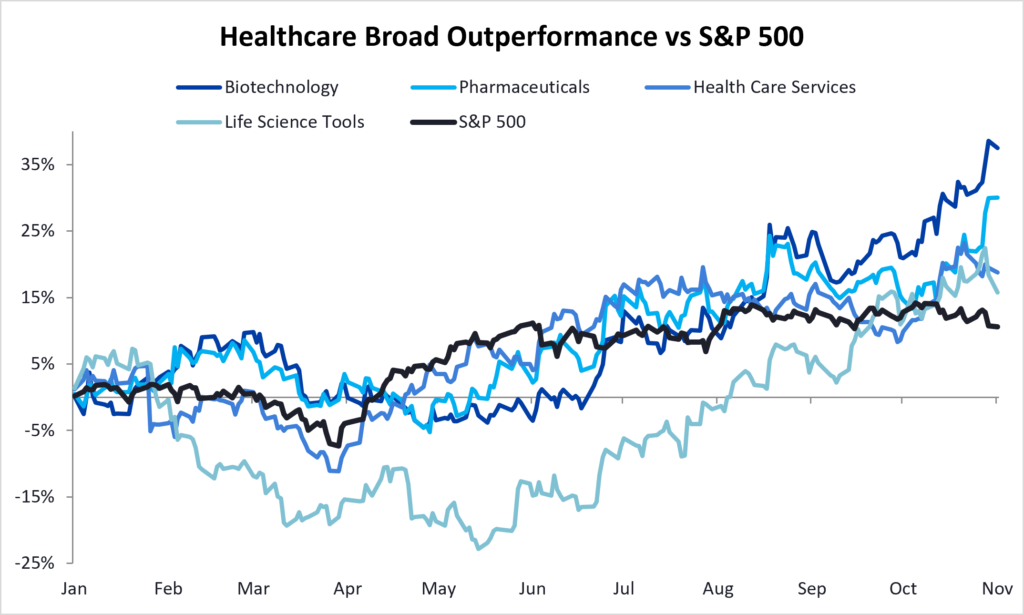
Source: Bloomberg LP. As of November 2, 2026
Eli Lilly generated impressive sales growth of 39% during the third quarter following the launch of daily pills and expanded reimbursement for seniors under Medicare. Thermo Fisher accelerated to its fastest growth rate since 2021, reflecting demand for laboratory equipment across drug discovery, clinical trials, and manufacturing applications. Biotechnology rebounded after a brief pullback in September and was the best-performing sub-sector, delivering a return of +13%. We maintained an overweight position in our portfolio because biotechnology companies are best positioned to deploy AI to identify successful drug candidates faster and commercialize them at a lower cost. They also benefit from record levels of funding (+86% to $90bn YTD), and many have received attractive bids to be acquired by larger pharmaceutical manufactures seeking to bolster their innovation pipelines.
In October, we saw several positive developments with our positions in the health insurers. First, Humana announced that the Centers for Medicare and Medicaid Services (CMS) re-evaluated the performance of their Medicare Advantage plans and announced an upgrade under the STAR Rating System. Now >95% of plan members are in the highest tier compared to 20% in 2025. This is best-in-class compared to peers and qualifies Humana for bonus payments from CMS. Second, UnitedHealth posted quarterly results that were ahead of expectations and raised its guidance. They cited moderating cost trends and growth in its specialty pharmacy business called OptumRx. We’re encouraged to see this return to consistent execution which is necessary for UnitedHealth to rebuild trust with investors after a challenging 2025. Finally, we initiated a position in Molina Healthcare, which specializes in delivering care for low-income Americans under Medicaid. Molina has demonstrated recent success in managing utilization and extracting incremental reimbursement from the states, which gives us confidence that they can deliver on their target to increase EPS from $5 in 2026 to $25 in 2030. Moreover, Molina will benefit from the Democrats reclaiming the U.S. House of Representatives and Senate because one of their top priorities is to expand enrollment in Medicaid and restore subsidies on the Affordable Care Act (ACA) Exchange.
Healthcare remains under-owned across most portfolios despite the recent outperformance. We think defensiveness, consistent cash generation, and low correlation to the broader market is a compelling combination for investors. We balance our portfolio allocation between stable dividend growers and disruptors who are developing new therapies and pushing the frontier of medical innovation.
Infrastructure
Middlefield Fund Tickers & Codes: MINF / MID 265 / MID 510 / ENS / IS / IS.PR.A / MID 800
November’s U.S. midterms dominated the conversation for infrastructure investors, with the Democratic flip weighing on sentiment towards the data center buildout. We see the initial reaction as a knee-jerk repricing of headline risk rather than a change in fundamentals. Policy clarity will take time, but the demand behind the buildout does not disappear with an election. If tougher rules in the U.S. slow the more speculative corners of data centre development, we believe capital will look for jurisdictions that can deliver power quickly and affordably. Alberta fits that description well, with supportive regulation, abundant natural gas and comparatively low input costs, and we expect it to gain share of investment over time rather than lose it.
Third-quarter results reaffirmed our approach: own the infrastructure behind the AI data centre build-out rather than chase its more speculative segments. Contracted, fee-based business models allowed our holdings to grow earnings and maintain or raise guidance despite the political noise. Enbridge delivered the steady execution we expected, growing EBITDA to $4.4 billion, while placing $3 billion of gas transmission projects into service and reaffirming 2026 guidance. Its highly contracted, long-term cash flows underpin the ~5% EBITDA CAGR out to the end of the decade. TC Energy offered the clearest signal of confidence, raising its 2026 outlook and extending its 5-7% growth target to 2031, backed by $6 billion of projects sanctioned this year at roughly 6.5x EBITDA. AltaGas delivered a record quarter, with EBITDA up 45% on LPG exports to Asia of more than 147,000 barrels per day, a reminder that Canadian energy is steadily diversifying away from a single customer. Pembina grew EBITDA 9% and is trending toward the top of its guidance range, supported by rising basin activity that should continue to fill its systems.
On the power side, TransAlta reaffirmed its outlook while advancing its Keephills data centre project, now the Boreal Technology Hub, which we view as one of the more tangible ways to participate in Alberta’s emergence as a data centre destination. Brookfield Renewable grew FFO per unit 11% and closed its Boralex acquisition, while recycling capital at mid-teens returns. Taken together, we believe the long-term need for power, gas and midstream capacity is intact, and our Infrastructure and Diversified funds remain positioned to benefit as political noise gives way to fundamentals.
Technology & Communications
Middlefield Fund Tickers & Codes: MINN / SIH.UN / MID 925 / MDIV
by Shane Obata, Portfolio Manager
The latest earnings season provided some of the most compelling evidence yet that the AI investment cycle remains firmly intact. Amazon Web Services, Microsoft Azure and Google Cloud delivered revenue growth of 39%, 48% and 103%, respectively, representing approximately 56% aggregate growth across the three businesses. These are extraordinary numbers considering their enormous scale. Equally impressive is the profitability underpinning that growth, with AWS and Google Cloud generating operating margins approaching 40%.
For investors debating the return on investment from AI, we believe these are among the most important numbers to watch. While attention has focused heavily on the enormous capital expenditures required to build AI infrastructure, cloud revenues provide tangible evidence of customers paying for increasingly sophisticated computing services. Importantly, this growth is occurring within highly profitable businesses, strengthening the economic justification for continued investment.
Against this backdrop, the recent indiscriminate selling across technology, particularly semiconductors, appears increasingly disconnected from underlying demand. The recent pushed the Nasdaq into correction territory closing below its 200-day moving average. The index has done this twice recently, after the April 2025 “Liberation Day” sell-off and again after the Iran war began earlier this year, and both times it recovered quickly and resumed its uptrend. We acknowledge that the political environment has become more challenging. The Democratic sweep in the U.S. midterm elections, including Gina Hinojosa’s victory in Texas, introduces uncertainty around the pace and economics of future data centre construction. Concerns about electricity affordability, water consumption and the impact of data centres on local communities are entirely reasonable. We expect policymakers to demand stronger protections and potentially impose more restrictive permitting requirements. This could increase costs and delay projects, particularly in Texas, where the governor-elect has proposed a temporary moratorium on new approvals.
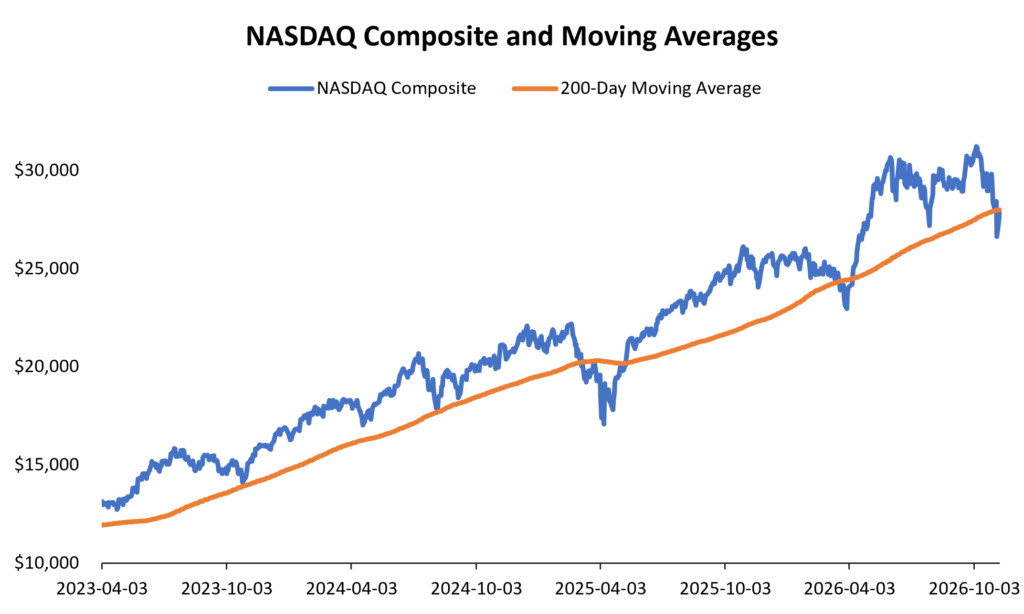
Source: Bloomberg LP. As of November 9, 2026
Nevertheless, we believe investors risk extrapolating these challenges too far. AI infrastructure has become an important contributor to U.S. economic growth and competitiveness. States such as Texas have significant incentives to retain these investments, particularly when projects can relocate to more accommodating jurisdictions. We also expect policymakers to increasingly recognize the economic benefits alongside the legitimate concerns of local communities.
Our expectation is therefore not that the buildout stops, but that some projects become more expensive, others face delays and investment increasingly gravitates toward favourable jurisdictions.
Ultimately, we believe the market is confusing a more challenging regulatory environment with deteriorating demand for AI. The latest cloud results suggest those are two very different things.
Resources
Middlefield Fund Tickers & Codes: MID 800 / MID 161 / MID 265 / MRF FT LP / Discovery FT LP
by Dennis da Silva, Senior Portfolio Manager
The tighter monetary backdrop that began with the Fed’s September hike continued with bullion suffering its worst October performance since 2008 and closing the month near a one-year low. Gold equities significantly underperformed broad North American markets in October, evident in the 13.2% decline of the S&P/TSX Gold Index. The selloff was driven by a liquidity shock from the AI-related equity rout, higher Treasury yields, a stronger dollar, and renewed expectations of further Fed tightening. Central-bank demand remained a key offset, with the World Gold Council reporting record Q3 2026 purchases (up 42% year-on-year), reinforcing the strategic demand backdrop. Despite elevated volatility and an uncertain macro backdrop, in our view, gold producers are on their soundest footing in years. Balance sheets are strong, margins are healthy and, importantly, capital allocation discipline remains high. The lack of meaningful discoveries along with steady production and reserve grade declines is a challenge that is not going away and will only necessitate higher incentive pricing over the long term. November has so far rewarded our conviction in gold miners such as Barrick and Iamgold, as bullion has rallied on the sharp decline in 10-year Treasury yields.
October was a month of renewed escalation on the oil and gas front: crude oil posted its strongest monthly gain since the conflict began, while European natural gas prices pushed to their highest levels since 2022 as the Strait of Hormuz crisis deepened rather than eased. Higher oil prices are supportive of free cash flow across the sector, but the benefit is increasingly differentiated by downstream integration and heavy oil exposure. Widening WCS heavy differentials reflect a combination of growing Venezuelan imports into the US, refinery disruptions, growing WCSB heavy oil supply and tighter pipeline utilization. U.S. natural gas prices fell as record production and above-average temperature forecasts kept the domestic market comfortably supplied despite the global squeeze. For investors, this is a market that increasingly rewards resilience over momentum: North American producers and LNG exporters with direct pipeline-to-export exposure remain the structural winners, capturing premium international pricing while enjoying stable domestic feedstock costs. The S&P/TSX Capped Energy Index was up an impressive 12.7% in October, as the 12.1% in WTI offset the 4.2% decline in Nymex natural gas.
In BC, the Conservative Party won a landslide victory, its first election win in nearly a century. The Conservatives campaigned on a promise to fast-track permitting, with a “one project, one review” system encompassing strictly legislated approval timelines. The party also plans to expand the provincial Mining Exploration Tax Credit and committed to temporary Provincial Sales Tax (PST) exemptions on critical equipment and software to attract investments. The new Premier has indicated a goal to significantly grow natural gas production and LNG exports by doubling natural gas production by 2032 and more than triple it by 2035. At the Federal level, Bill C-39, which proposes a one-year timeline for federal reviews on major resource and infrastructure projects, passed the second reading on October 8th and was sent to a special committee. It is expected to receive Royal Assent as early as December, following the third and final review in November.
Exchange Traded Funds (ETFs)
Mutual Funds (Series A | F | I | O)
TSX-Listed Closed-End Funds
| Fund | Ticker | Strategy |
|---|---|---|
| MINT Income Fund | MID.UN | Equity Income |
| Sustainable Innovation & Health Dividend Fund | SIH.UN | Innovation & Healthcare |
TSX-Listed Split Share Corps. (Class A | Preferred)
| Fund | Ticker | Strategy |
|---|---|---|
| E-Split Corp. | ENS | ENS.PR.A | Energy Infrastructure |
| Real Estate Split Corp. | RS | RS.PR.A | Real Estate |
| Infrastructure Dividend Split Corp. | IS | IS.PR.A | Infrastructure |
LSE-Listed Fund
| Fund | Ticker | Strategy |
|---|---|---|
| Middlefield Canadian Enhanced Income UCITS ETF | LSE: MCTC | LSE: MCTP | Canadian Equity Income |
Commissions, trailing commissions, management fees and expenses all may be associated with mutual fund investments, including ETFs. Please read the prospectus before investing. You will usually pay brokerage fees to your dealer if you purchase or sell units/shares of investment funds on the Toronto Stock Exchange or other alternative Canadian trading system (an “Exchange”). If the units/shares are purchased or sold on an Exchange, investors may pay more than the current net asset value when buying and may receive less than the current net asset value when selling them. There are ongoing fees and expenses associated with owning units or shares of an investment fund. An investment fund must prepare disclosure documents that contain key information about the fund. You can find more detailed information about the fund in these documents. Mutual funds and investment funds are not guaranteed, their values change frequently and past performance may not be repeated. Certain statements in this disclosure are forward-looking. Forward-looking statements (“FLS”) are statements that are predictive in nature, depend upon or refer to future events or conditions, or that include words such as “may”, “will”, “should”, “could”, “expect”, “anticipate”, “intend”, “plan”, “believe”, or “estimate”, or other similar expressions. Statements that look forward in time or include anything other than historical information are subject to risks and uncertainties, and actual results, actions or events could differ materially from those set forth in the FLS. FLS are not guarantees of future performance and are by their nature based on numerous assumptions. Although the FLS contained herein are based upon what Middlefield Funds and the portfolio manager believe to be reasonable assumptions, neither Middlefield Funds nor the portfolio manager can assure that actual results will be consistent with these FLS. The reader is cautioned to consider the FLS carefully and not to place undue reliance on FLS. Unless required by applicable law, it is not undertaken, and specifically disclaimed that there is any intention or obligation to update or revise FLS, whether as a result of new information, future events or otherwise.
This material has been prepared for informational purposes only without regard to any particular user’s investment objectives or financial situation. This communication constitutes neither a recommendation to enter into a particular transaction nor a representation that any product described herein is suitable or appropriate for you. Investment decisions should be made with guidance from a qualified professional. The opinions contained in this report are solely those of Middlefield Limited (“ML”) and are subject to change without notice. ML makes every effort to ensure that the information has been derived from sources believed to reliable, but we cannot represent that they are complete or accurate. However, ML assumes no responsibility for any losses or damages, whether direct or indirect which arise from the use of this information. ML is under no obligation to update the information contained herein. This document is not to be construed as a solicitation, recommendation or offer to buy or sell any security, financial product or instrument.