Index
Macro Update
by Dean Orrico, President & CEO and Robert Lauzon, CIO
August delivered plenty of volatility under the surface while broad indices continued to grind higher. Q2 earnings came in much stronger than expected with total returns of the TSX Composite (+3.0%) leading the S&P 500 (+2.6%) and the MSCI ACWI (+2.6%) despite heightened trade tensions with our neighbour to the south. Fueled by Nvidia’s solid fiscal Q2 results, the AI enthusiasm returned after a late July correction. Nvidia Q2 numbers included a guide to 70% revenue growth next fiscal year, well ahead of consensus expectations. This resulted in countries exposed to the “picks and shovels” of this digital infrastructure buildout to produce stellar monthly returns of +6.3% (Taiwan) and +5.8% (Korea). Overall Q2 earnings reinforced the durability of this theme, with S&P 500 Technology forward earnings now up nearly 82% year-over-year, more than double the broader index. Industrials, Materials, and Communication Services also posted robust growth as AI-related capital spending filters through the economy. Encouragingly, earnings strength is no longer confined to the largest names, with the gap between Magnificent 7 earnings growth and the rest of the S&P 500 narrowing, a healthy sign of broadening participation of economic growth. This shift showed up clearly in performance, with the S&P 500 Energy (+7.0%), Technology (+6.3%), Materials (+6.0%) and Healthcare (+4.8%) sectors leading the market in August, while more defensive, rate-sensitive sectors such as Utilities (-4.8%) and Real Estate (-1.9%) lagged primarily because of a sharp rise in the U.S. 10 Year Treasury yield.
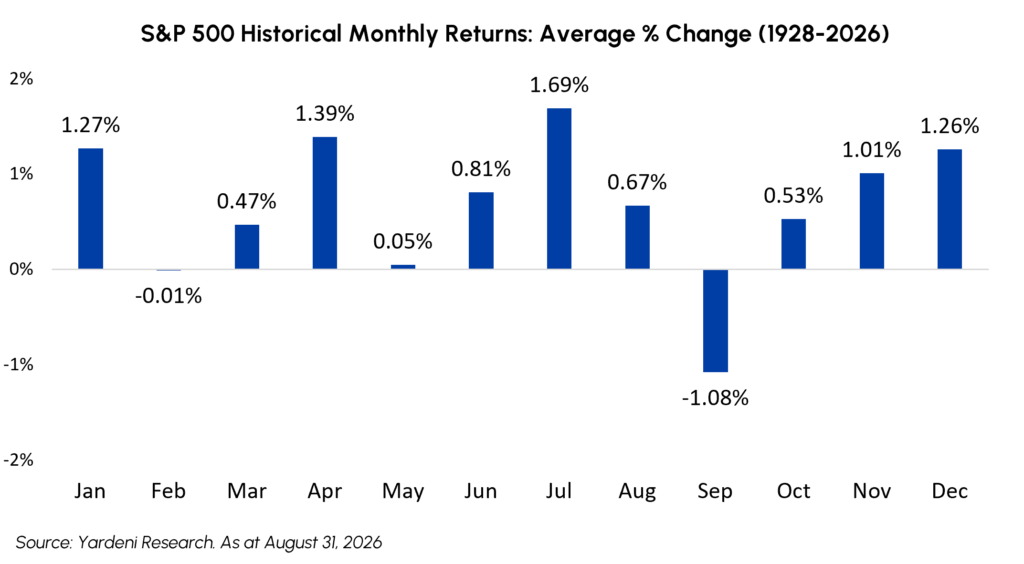
We expect choppy consolidation during a seasonally weak September (see figure below) and into the US Midterm elections as markets digest ongoing geopolitical risks, rising Fed rate hike expectations, state election noise generating a negative narrative around the datacentre buildout and pressure on global bond yields. Equity investors have remained watchful of how the path for rates could affect valuations in more duration-sensitive corners of the market, even as the broader earnings backdrop remains supportive. We believe broad earnings growth into 2027 will be the catalyst to drive equities going forward and view the cooling off period mentioned above as a healthy pullback setting the stage for further new highs later this year and into 2027.
Here in Canada, bank earnings kicked off the domestic reporting season on solid footing, while trade and energy infrastructure headlines continued to dominate investor attention. The TSX Materials sector posted standout gains of 25.7% in August, while Energy was flat, lagging its U.S. counterpart. Looking ahead, Canada is hosting its inaugural Investment Summit on September 14-15 in Toronto, bringing together the world’s largest investors, global CEOs, and business leaders. Co-hosted by the federal government in partnership with CPP Investments and PSP Investments, the Summit aims to catalyze $1 trillion in new investment over the next five years, with a strategic focus on energy, critical minerals, and technology/AI sectors. For Canada, this represents a transformational opportunity to unlock high-paying job creation, strengthen economic competitiveness, and position the nation as a global investment destination, building on recent momentum that has already secured $97 billion in foreign investment commitments.
Real Estate
Middlefield Fund Tickers & Codes: MREL / MID 600 / RS / RS.PR.A
by Dean Orrico, President & CEO
Canadian REITs had a challenging August despite a relatively in-line Q2 earnings season. The disconnect was almost entirely attributable to rising bond yields which reignited the market’s sensitivity to interest-rate sensitive equities. We would emphasize that this was a sentiment-driven pullback rather than a fundamental one, given earnings were broadly neutral to better-than-expected, as same-property NOI growth remains solid across most sub-industries. We view this as a favorable setup for the sector once interest rate volatility subsides and we remain confident that fundamentals across our preferred holdings are as strong as they have been in some time.
The most notable single-stock event this month was H&R REIT’s announced takeover by GO Residential. We view this transaction with considerable concern and reservation from a governance standpoint. In our view, H&R’s strategic review over the past few years has yielded a less-than-optimal outcome, thereby leaving the trust in a weaker negotiating position. While it’s diversified asset base makes it more challenging to find a single buyer for the whole company, a significant portion of its assets, including the US multi-family platform and its Canadian industrial properties, are highly desirable and should command competitive prices from prospective buyers. In the end, however, the proposed transaction announced on August 11, 2026 is lacking in many respects and does not seem to treat all shareholders fairly. We will continue to monitor the situation very closely while engaging with various stakeholders, including fellow investors and company management and trustees, to ensure we’re treated fairly in any proposed acquisition transaction.
On a more constructive note, RioCan remains a standout holding within our retail allocation, with the trust’s grocery-anchored, necessity-based portfolio continuing to demonstrate exceptional pricing power. Specifically, renewal leasing spreads continue to run well ahead of expectations year to date, and we view RioCan as one of the more attractive risk-adjusted opportunities in the retail sector.
The seniors housing sector and Sienna Senior Living continue to be very attractive. While occupancy across the portfolio is approaching practical capacity limits, we see multiple levers to sustain double-digit FFO per share growth, including ongoing operational optimization, portfolio rebalancing, margin expansion, and gradual rent increases. Combined with a structurally aging population supporting solid demand growth for years to come, we believe Sienna represents an exceptional long-term core holding in our real estate funds.
Healthcare
Middlefield Fund Tickers & Codes: MHCD / MID 325 / SIH.UN
by Dean Orrico, President & CEO
Healthcare experienced sustained momentum for a third consecutive month. The S&P 500 Health Care Index is +15% since Jun 1 compared to the S&P 500 +1%. In August, performance was led by Biotechnology +9%, Life Science Tools +7%, and Pharmaceuticals +3%.
The performance in Biotechnology reflects robust funding and favourable clinical trials results. We’re encouraged by the pace of innovation and there is increasing evidence that AI is helping drug developers identify successful candidates faster. This increase in activity is a boon for clinical research organizations (CROs) which offer outsourced clinical trial services. We recently purchased shares of Medpace which specializes in areas attracting an outsized share of recent funding, including oncology, cardiovascular, and metabolic therapies.
Eli Lilly is our largest position and reported another impressive quarter. Sales grew by nearly 50%, supported by expanded reimbursement under Medicare and the launch of their new oral pill, Foundayo. Large Pharma is positioned to benefit from this wave of innovation by acquiring promising new molecules and developing them internally. This was exemplified by Merck’s breakthrough Phase 3 results for a new skin cancer treatment that uses messenger RNA to train your immune system to attack malignant cells. The drug was developed in a 50/50 joint venture with Moderna and could generate >$10 billion in peak sales if it can demonstrate results in other cancers such as kidney and lung. We are overweight Merck and it is the fourth largest position in our healthcare fund. The stock increased +13% in August and is +39% YTD. Pharmaceuticals enjoy intellectual property protection that allows them to earn attractive 60-80% gross margins while efficiently converting volume growth into incremental profits.
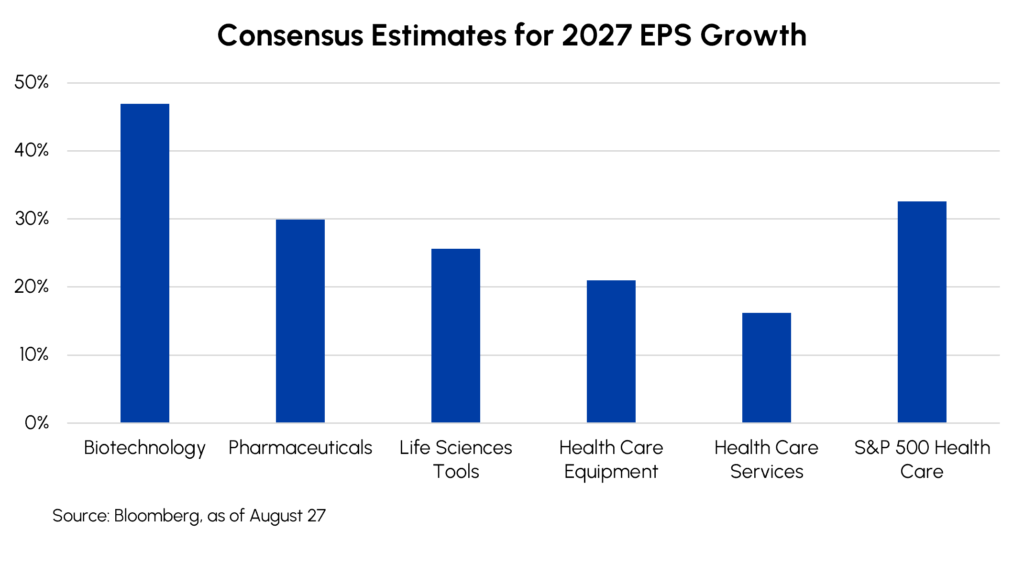
The chart below shows consensus earnings estimates for 2027, which are broad-based but strongest in Biotechnology and Pharmaceuticals. These sub-sectors represent approximately two-thirds of the portfolio and are supported by positive earnings revisions which drive stock performance over time.
Our overweight position in Biotechnology has generated above-market returns with lower volatility by leveraging our proprietary PDUFA Model, deployed in partnership with our advisors at SSR.
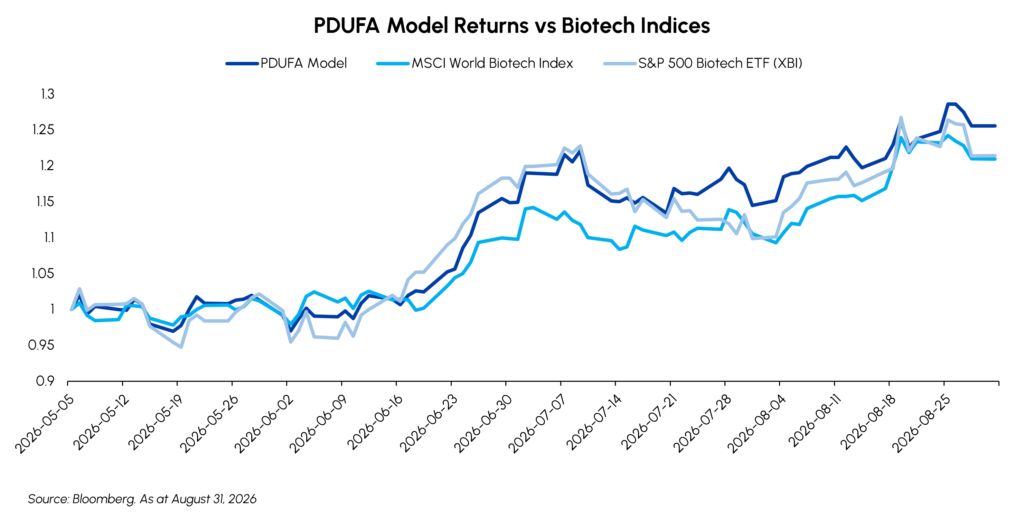
MedTech has recovered some of its YTD underperformance, led by Abbott Laboratories, Edward Life Sciences, and Dexcom, all of which posted strong second quarter results and raised their full-year outlooks. We’re underweight Managed Care because insurers continue to face enrollment headwinds within Affordable Care Act and Medicaid. We think these stocks could trade around campaign rhetoric heading into the midterm elections, potentially creating opportunities to add to our favourite names at a discount to their intrinsic value.
Infrastructure
Middlefield Fund Tickers & Codes: MINF / MID 265 / MID 510 / ENS / IS / IS.PR.A / MID 800
August reinforced a theme we’ve highlighted throughout the year: Canadian energy infrastructure continues to generate durable, growing cash flow while volatility persists geopolitically and within commodity prices. Moreover, a series of transactions and regulatory developments have only strengthened our conviction in core holdings across the sector.
Enbridge was very topical during August, announcing a $2.7 billion joint venture with KKR and Apollo on its Westcoast Pipeline system, alongside a US$600 million acquisition of Salt Creek Midstream’s Permian gathering assets. Both transactions reflect the company’s disciplined approach to capital allocation: the Westcoast partnership recycles capital out of a lower-returning, lower-risk asset into higher-growth opportunities while Enbridge retains control and operatorship, and the Permian acquisition extends its wellhead-to-water franchise by connecting directly into export capacity at Ingleside. Enbridge’s Mainline is running near full capacity with zero apportionment in September, while Trans Mountain has filed for expansion approval that would lift system capacity by 90,000 barrels per day, alongside a separate $4 billion optimization proposal targeting an additional 210,000 barrels per day by 2028. Producers continue to build toward the Pathways carbon capture project, a key enabler for future export growth. Taken together, these developments underscore a sector executing well in the present while continuing to build the foundation for the next decade of growth, precisely the kind of durable, multi-year opportunity we continue to favour across our core holdings. The past twelve months have brought a wave of foreign capital into Canadian energy infrastructure, including Apollo’s stake in Pembina Gas Infrastructure and Shell’s pending acquisition of ARC Resources, a signal that global investors increasingly view Canadian energy assets as attractive, investable, and strategically relevant.
South of the border, a different dynamic is unfolding. Regulatory pushback on data centre development has intensified, with Pennsylvania’s governor imposing strict new cost-responsibility and permitting requirements on AI data centres while Texas regulators work through an unprecedented volume of large-load interconnection requests amid record summer power demand. The result has been a rockier approval path for new data centre and power projects in key U.S. markets, alongside some volatility for U.S. power and midstream equities. We view this as a constructive backdrop for Alberta’s independent power producers. TransAlta and Capital Power have comparatively sidestepped this turbulence, benefiting from a jurisdiction that has moved with more clarity and speed on data centre power frameworks, a dynamic that reinforces Alberta’s position as an increasingly credible, lower-friction alternative for AI infrastructure investment.
Technology & Communications
Middlefield Fund Tickers & Codes: MINN / SIH.UN / MID 925 / MDIV
by Shane Obata, Portfolio Manager
The durability of the AI investment cycle is increasingly visible further down the supply chain. Applied Materials says its largest customers are now providing rolling eight-quarter forecasts, giving the semiconductor equipment ecosystem unusually long visibility into future fab ramps. Memory looks similarly constrained: TrendForce expects DRAM supply to remain tight through 2027, with meaningful new capacity not contributing until 2028. The same pattern is appearing in advanced packaging. DigiTimes reports that Nvidia, AMD and hyperscalers are already locking in ABF substrate capacity through 2028, with suppliers being pushed to plan additional capacity for 2029 and 2030. For MINN, this is exactly the type of environment we want to exploit: sustained demand meeting structurally constrained supply across the picks and shovels of AI.
The alpha opportunity also remains distinctly global. Undervaluation persists among Japanese companies at the intersection of improving corporate governance, stronger capital discipline and world-class technology leadership. Recent research suggests Tokyo Stock Exchange reforms are helping investors reprice chronically undervalued businesses, while AI infrastructure investment is creating opportunities across semiconductor equipment, electronic components and precision manufacturing. We are also increasing exposure to Taiwan and Korea. Despite being home to many of the world’s most strategically important semiconductor companies, both remain classified by MSCI as emerging markets and therefore sit outside the developed-market MSCI World Index. That matters. A core part of MINN’s value proposition lies in diverging from the benchmark to identify global leaders that North American investors systematically overlook.
We are also increasingly constructive on high-quality gaming IP. Sony combines a PlayStation ecosystem with more than 125 million active users and an unusually deep content portfolio spanning franchises such as Marvel’s Spider-Man, God of War, The Last of Us and Ghost. The cost of memory remains a near-term hardware headwind, but Sony has secured the input volumes required for 2026. In our view, easing component costs should eventually improve console economics while the value of the underlying ecosystem continues to compound.
Finally, we see significant value in Take-Two. Rockstar’s new 27-minute GTA VI extended look, captured entirely in-game on PlayStation 5, was visually exceptional and reinforced our view that GTA is becoming as much a cinematic entertainment property as a videogame. Pre-orders have already been described by management as unprecedented, while Take-Two continues to guide to record fiscal 2027 bookings. At current levels, we believe the market is still underestimating the durability and monetization potential of truly scarce, world-class gaming IP.
Resources
Middlefield Fund Tickers & Codes: MID 800 / MID 161 / MID 265 / MRF FT LP / Discovery FT LP
by Dennis da Silva, Senior Portfolio Manager
Gold equities staged a significant reversal in August, breaking a five-month streak of underperformance relative to broad North American markets. Bullion rose 10.1% on the month, while the S&P/TSX Gold Index surged 32.2%, marking its best monthly performance for gold stocks since January and offering clear signs of a recovery after a prolonged period of limited activity. The primary catalyst was a shift in macro expectations as concerns around fiscal sustainability, currency debasement, and the long-term trajectory of U.S. debt moved back to the forefront of investor attention. Central bank purchases remained a key structural support as well, with quarterly demand at its strongest pace since Q4 2024. With equity breadth improving alongside the price recovery, the broader setup now favours a continued constructive trend heading into the fall, particularly if rate-hike expectations fade alongside constructive PCE prints and investor inflows persist.
The S&P/TSX Capped Energy Index gained 2.5% in August, supported by a 1.3% increase in oil and a 6.8% gain in natural gas prices. Crude remained volatile through the month as traders navigated recurring headlines around Strait of Hormuz risk. The diesel crack spread broke above US$100/bbl for the first time on record, 5x its typical range, reflecting a near-total absence of spare global refining capacity after roughly 5 million barrels per day was taken offline through Ukrainian strikes on Russian refineries and Iranian strikes on Middle Eastern facilities. Late in the month, President Trump announced a deal with the Venezuelan government that could see the U.S. take partial ownership in 17 oil fields holding an estimated 65 billion barrels of proved reserves, almost entirely heavy oil. While the timing and scale of any resulting production growth remain uncertain, the development could be a long-term headwind for Canadian heavy oil producers and a useful reminder of why increased oil pipeline egress to Canadian coasts remains so important for Canadian exports.
Outside North America, European natural gas benchmark prices surged approximately 23% over the month to their highest level since early 2023, as storage levels fell well below the five-year average and hit their lowest seasonal point since 2009. Supply constraints deepened further as LNG flows through the Strait of Hormuz collapsed roughly 95% since the start of the Iran conflict, removing close to a fifth of global LNG supply and pushing Europe into direct competition with Asia for scarce spot cargoes. As a result, average Asian spot prices in August were nearly double year-ago levels. Holdings in Middlefield’s ActivEnergy strategy including Tourmaline, Vermilion and Tenaz all are benefitting from higher European natural gas prices to varying degrees.
Exchange Traded Funds (ETFs)
Mutual Funds (FE | F)
TSX-Listed Closed-End Funds
| Fund | Ticker | Strategy |
|---|---|---|
| MINT Income Fund | MID.UN | Equity Income |
| Sustainable Innovation & Health Dividend Fund | SIH.UN | Innovation & Healthcare |
TSX-Listed Split Share Corps. (Class A | Preferred)
| Fund | Ticker | Strategy |
|---|---|---|
| E-Split Corp. | ENS | ENS.PR.A | Energy Infrastructure |
| Real Estate Split Corp. | RS | RS.PR.A | Real Estate |
| Infrastructure Dividend Split Corp. | IS | IS.PR.A | Infrastructure |
LSE-Listed Fund
| Fund | Ticker | Strategy |
|---|---|---|
| Middlefield Canadian Enhanced Income UCITS ETF | LSE: MCTC | LSE: MCTP | Canadian Equity Income |
Commissions, trailing commissions, management fees and expenses all may be associated with mutual fund investments, including ETFs. Please read the prospectus before investing. You will usually pay brokerage fees to your dealer if you purchase or sell units/shares of investment funds on the Toronto Stock Exchange or other alternative Canadian trading system (an “Exchange”). If the units/shares are purchased or sold on an Exchange, investors may pay more than the current net asset value when buying and may receive less than the current net asset value when selling them. There are ongoing fees and expenses associated with owning units or shares of an investment fund. An investment fund must prepare disclosure documents that contain key information about the fund. You can find more detailed information about the fund in these documents. Mutual funds and investment funds are not guaranteed, their values change frequently and past performance may not be repeated. Certain statements in this disclosure are forward-looking. Forward-looking statements (“FLS”) are statements that are predictive in nature, depend upon or refer to future events or conditions, or that include words such as “may”, “will”, “should”, “could”, “expect”, “anticipate”, “intend”, “plan”, “believe”, or “estimate”, or other similar expressions. Statements that look forward in time or include anything other than historical information are subject to risks and uncertainties, and actual results, actions or events could differ materially from those set forth in the FLS. FLS are not guarantees of future performance and are by their nature based on numerous assumptions. Although the FLS contained herein are based upon what Middlefield Funds and the portfolio manager believe to be reasonable assumptions, neither Middlefield Funds nor the portfolio manager can assure that actual results will be consistent with these FLS. The reader is cautioned to consider the FLS carefully and not to place undue reliance on FLS. Unless required by applicable law, it is not undertaken, and specifically disclaimed that there is any intention or obligation to update or revise FLS, whether as a result of new information, future events or otherwise.
This material has been prepared for informational purposes only without regard to any particular user’s investment objectives or financial situation. This communication constitutes neither a recommendation to enter into a particular transaction nor a representation that any product described herein is suitable or appropriate for you. Investment decisions should be made with guidance from a qualified professional. The opinions contained in this report are solely those of Middlefield Limited (“ML”) and are subject to change without notice. ML makes every effort to ensure that the information has been derived from sources believed to reliable, but we cannot represent that they are complete or accurate. However, ML assumes no responsibility for any losses or damages, whether direct or indirect which arise from the use of this information. ML is under no obligation to update the information contained herein. This document is not to be construed as a solicitation, recommendation or offer to buy or sell any security, financial product or instrument.