Index
Macro Update
by Dean Orrico, President & CEO and Robert Lauzon, CIO
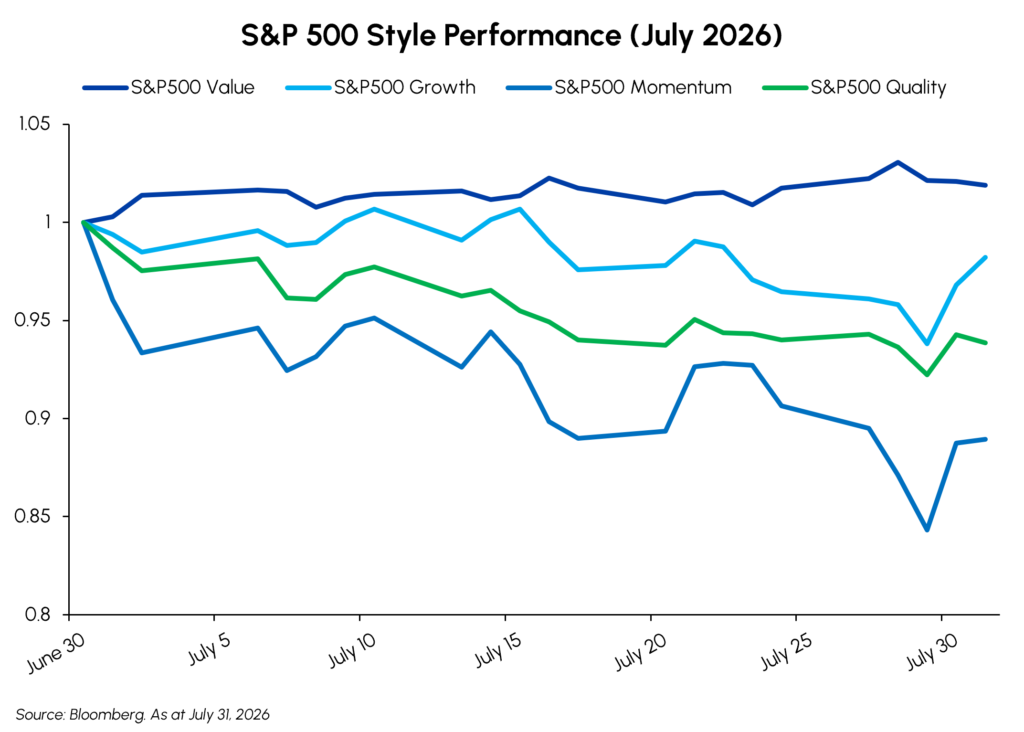
July played out as expected — a summer stall marked by volatility rather than a correction. The S&P 500 has been rangebound since mid-May with sector leadership churning beneath the surface supporting a market broadening. Market support was tested during the final week of July: Leopold Aschenbrenner’s $45 billion Situational Awareness fund was forced to unwind its entire public book to Citadel after AI-trade losses triggered margin calls, and Warsh stumbled through his first press conference — yet the S&P still closed the week in positive territory. The days since have brought one of the sharpest momentum unwinds on record, punishing this year’s crowded winners. The underlying story, however, looks intact — earnings keep beating, AI investment remains firm, and the economy is slowing only at the margins. Positioning is now considerably cleaner and hedge fund gross exposure has come down meaningfully — a setup that has historically preceded stronger performance over the following month. The S&P 500 finished July essentially flat (-0.1%) but remains up a healthy +10.1% year-to-date. As mentioned, beneath the calm index-level return, a powerful rotation is occurring with a decisive shift away from mega-cap technology and toward value, defensives and dividend-paying sectors. As a result, the equal-weight S&P 500 quietly hit an all-time high — a sign of genuine breadth. The TSX outperformed with a +1.2% gain in July, bringing its 2026 year-to-date return to an impressive +12.5%. Energy (+6.9%) was the best performing sector during the month.
The U.S.-Iran peace deal and memorandum of understanding collapsed in early July after initial violations escalated into renewed military conflict. WTI rose +22% during the month, contributing to Energy’s outperformance in the major equity indices. While the Federal Reserve held interest rates steady at its July 29 meeting, the decision was contentious. The key risk is higher for longer energy prices combined with robust AI capex spending, which is feeding into broader inflation and complicating the Fed’s forward path.
Q2 earnings season has delivered broadly positive results across most sectors. Despite some concern about the quality of the earnings due to mark-to-market gains for some private holdings within certain Mag-7 companies, true profit growth for the S&P 500 was still a very strong 26% Y/Y. U.S. banks posted record quarters while Health Care was a standout with 29 of 30 reporting S&P 500 companies beating EPS estimates. The overarching earnings narrative: profit growth is outpacing sales as companies defend margins through pricing discipline and automation, broadening the earnings story beyond mega-cap tech.
Looking ahead, we have been constructive on the Canadian economy given the government’s aggressive push on infrastructure investment and initiatives to attract foreign investment, particularly in the energy sector. May GDP recorded a 0.3% month-over-month increase, with preliminary data pointing to 3.4% annualized year-over-year growth in Q2. The Carney government continues at full speed to expand our trading partnerships and counter US tariff threats. Trump’s more recent proposed Section 338 tariffs are scheduled to take effect August 19 but the 30-day delayed implementation will provide some wiggle room for negotiation. While the 50% tariff headline number is high, we believe the scope is more limited as it impacts a modest 5-6% of Canada’s total exports to the US and raises Canada’s average effective tariff by only 2.5%.
The US economy remains strong, underpinned by solid manufacturing and service activities and consumer spending. The Canadian economy has picked up momentum. The macro backdrop is favorable to risk assets, and we expect the equity market to continue to do well. July reinforced a core principle of sound portfolio construction: diversification. Concentrated technology exposure detracted from returns, while balanced allocations across energy, real estate, infrastructure, and health care added meaningful value.
Fixed Income
Middlefield Fund Tickers & Codes: MSBP / MID 435
by Alexandre Cousineau, Head of Fixed Income
Global fixed income markets experienced broad-based losses in July as hawkish central bank rhetoric, oil-driven inflation concerns, and a historic wave of AI-related debt issuance drove yields sharply higher across every major sovereign curve.
In the United States, the curve bear steepened as the Federal Reserve held rates but struck a hawkish tone, with markets pricing an approximately 60% probability of a September hike by month-end. The 10-year Treasury yield rose 26 basis points to 4.74%, while the 2-year gained 11 basis points to 4.29%. The move was even more pronounced in Canada, where oil-driven inflation resurgence pushed the 10-year yield 28 basis points higher to 3.66%, even as the Bank of Canada held its policy rate steady. The selloff was global in scope, with Germany’s 10-year Bund also surging 33 basis points to 3.21%. Credit spreads widened in sympathy, with investment grade spreads 4 basis points wider at 78 bps OAS and high yield spreads 12 basis points wider at 279 bps. The primary driver was a historic wave of AI-related issuance — already more than double last year’s total — with Amazon’s $25 billion offering alone pushing technology spreads wider as investors approached capacity limits.
During the month, the portfolio rotated a portion of its Canada 2-year government bond holdings into U.S. 2-year Treasuries and UK 2-year government bonds, reflecting a more attractive risk-reward profile in the front end of those curves. The Canadian primary market was notably active in July, with a heavy calendar of new issuance across sectors. MSBP remained highly selective, participating opportunistically rather than broadly — even after this month’s spread widening, valuations remain tight and, in our view, do not adequately compensate for credit risk across much of the new-issue pipeline.
MSBP also established its first high-quality emerging markets position (USD based), investing in a ‘BB+’-rated issue from one of the largest petrochemical companies in Mexico. Separately, the portfolio added ‘AAA’-rated tranches of asset-backed securities collateralized by completed data centers, anchored by hyperscalers and/or “Magnificent Seven” tenants, with remaining lease terms of 13 years or longer.
At month-end, MSBP yielded 4.20%, representing approximately 110 basis points of carry over the Bloomberg Canada Aggregate Bond Index 1–3Y, with an overall portfolio duration of 1.50 years, approximately 0.3 years shorter than the benchmark. The portfolio remains credit-focused and highly selective given current valuations across global fixed income markets, with a continued tilt toward issues offering embedded upside optionality below their call price.
Real Estate
Middlefield Fund Tickers & Codes: MREL / MID 600 / RS / RS.PR.A
by Dean Orrico, President & CEO
The S&P/TSX Real Estate sector gained 0.3% in July, underperforming the broader S&P/TSX Composite Index (+1.2%). Middlefield Real Estate Dividend Class (MID 601) returned 0.84%, outperforming the S&P/TSX Real Estate benchmark. Year-to-date, the fund returned 14.80%, exceeding both the real estate benchmark and the broader S&P/TSX.
The Bank of Canada held its overnight rate steady at 2.25% throughout July, but the primary headwind came from the long end of the curve. The Canadian 10-year government bond yield rose from 3.38% at the start of the month to close at a peak of 3.64%, a meaningful 26 basis point backup that were a headwind to REIT valuations. This yield surge was driven by a combination of Middle East-driven oil price inflation (+23.5% for Brent crude in July), resilient US economic growth, and a divided and hawkish Federal Reserve which voted to hold interest rates steady at its July 29 meeting.
July was heavy with Q2 REIT earnings, and results overall were solid with residential and the office subsector being more challenged. Within the retail sub-sector, July’s trading performance was split as Primaris outperformed while Choice Properties, SmartCentres, and RioCan all declined. Notwithstanding the July drawdown, these retail REITs still posted impressive Q2 performance with Choice up 6.4%, SmartCentres gaining 13.9%, and RioCan increasing by 21%. July’s returns for industrial REITs were also mixed with Dream Industrial gaining and Granite remaining flat. Like the retail names, both Dream and Granite were up significantly in Q2 by 13.7% and 17.1%, respectively. Both the retail and industrial property sectors are benefiting from ongoing growth in rental rates due to continued strength in demand and constraints on new supply. Residential and urban office assets remain subdued, with Canadian Apartment Properties REIT and Allied Properties both underperforming.
The divergence between retail/industrial outperformers and residential/office laggards underscores the importance of active management and capitalizing on global real estate opportunities. A number of retail names, including Choice, Riocan and Primaris have been long time core holdings in the fund while we have been underweight Allied Properties and Canadian Apartment REIT. In addition, our long-term investment in Prologis proved highly beneficial, as it was the second-best performer in the U.S. and a significant contributor to our returns. In addition, two of our anchor holdings in the senior living space, Extendicare and Well Tower, continued to beat earning consensus and outperformed in July.
Canadian REITs were also active on the growth front with several striking partnerships with large private equity investors to support their acquisition and development pipelines. Boardwalk formed a joint venture with Desjardins Global Asset Management to grow through third-party acquisitions over time, with a focus on newer, higher-quality assets with attractive growth profiles. Dream Industrial teamed up with Dream Unlimited to acquire Chancerygate Ltd., a UK-based developer and asset manager of industrial property with a 30-year track record — a platform for accelerated growth in an important new market for Dream. Sienna Senior Living is forming a 50-50 joint venture with Fiera Infrastructure Inc. to expedite its long-term care redevelopment projects in Ontario, pairing Fiera’s capital with Sienna’s operating expertise to accelerate the pace of these redevelopments.
With Canadian long-term yields likely to remain volatile given geopolitical uncertainty in the Middle East and corresponding inflationary pressures, income-oriented clients should focus on REITs with growing dividends due to visible and increasing net operating income and robust leasing pipelines.
Healthcare
Middlefield Fund Tickers & Codes: MHCD / MID 325 / SIH.UN
by Dean Orrico, President & CEO
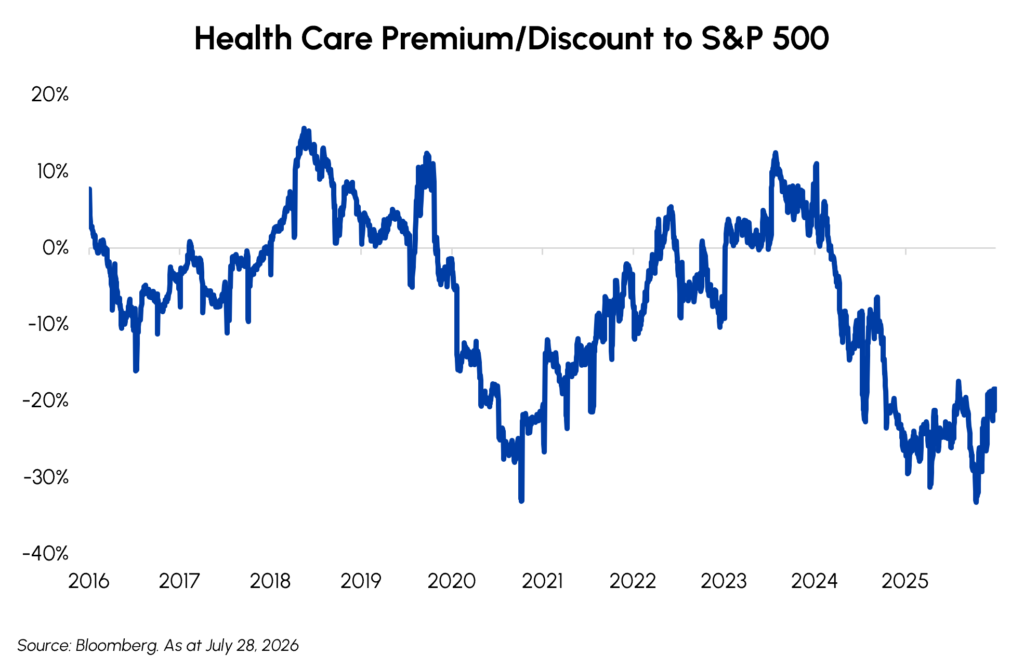
Healthcare outperformed the broader market by +2.5% in July, driven by better-than-expected quarterly results from holdings including Johnson & Johnson, UnitedHealth, and Thermo Fisher. The sector also benefitted from inflows as investors sought to diversify their portfolios outside of the AI theme. Healthcare trades at a near-record discount to the S&P 500, illustrating that the market has underappreciated the sector’s unique combination of defensiveness, demographic tailwinds (>10,000 Americans turn 65 every day), and competitive advantages underpinned by patents, regulatory approvals, and manufacturing expertise. Investors have the opportunity to own these companies at compelling valuations while fundamental earnings power is set to accelerate in 2027. We’re finally seeing a rotation back into Healthcare and in this environment our funds are positioned to deliver continued outperformance, especially compared to covered call strategies whose performance may be limited to their implicit capped upside.
We’ve seen particular strength within biotechnology, where valuations have been supported by robust funding across IPO/PE/VC, successful clinical trial results, and breakthrough FDA approvals. AI is helping companies identify promising drug candidates faster and at a lower cost, which we expect will stimulate a surge in new clinical trial starts. There has also been a record number of takeouts by large pharmaceutical producers, many of whom are facing expirations on patents covering their blockbuster drugs and are keen to replenish their pipelines. We have generated above-market returns with lower volatility by leveraging our proprietary PDUFA Model, deployed in partnership with our advisors at SSR. We also have exposure to this theme through Thermo Fisher, Danaher, and Waters, which supply equipment, instruments, and consumables to enable the next wave of innovation.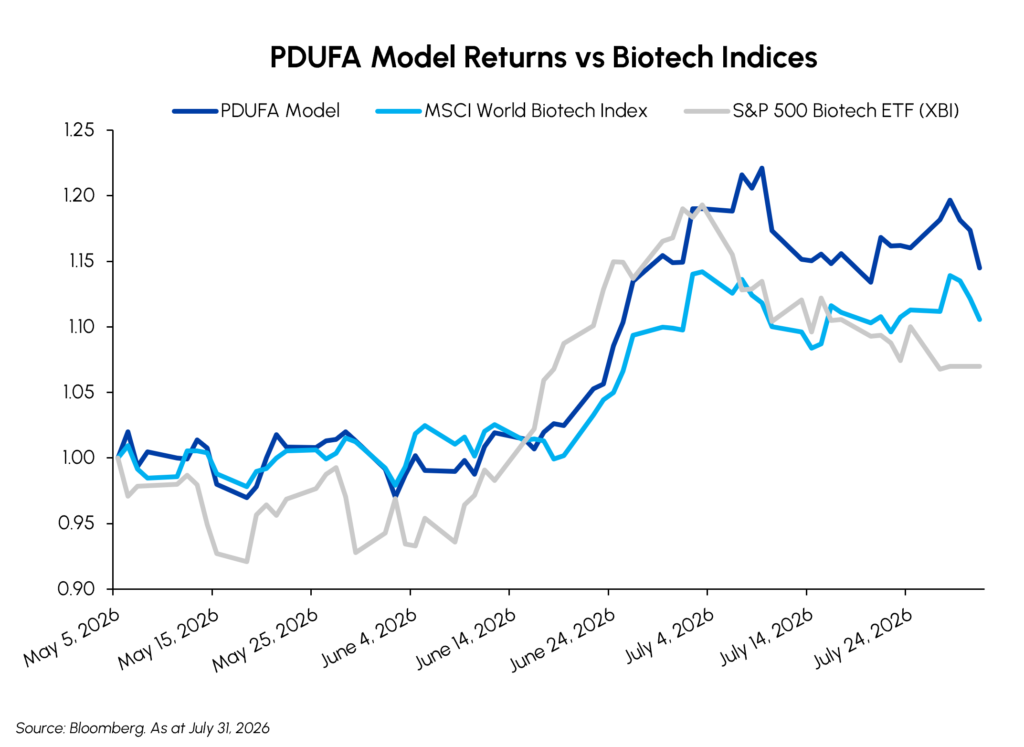
However, there remain pockets of weakness within the sector. The issue that captured headlines this earnings season was the expiration of Biden-era tax credits for insurance plans purchased on the Affordable Care Act (ACA) Exchange. Premiums for some policyholders doubled and many have been forced to drop insurance entirely. For many years, we’ve had no exposure to hospital operators, which bear the brunt of this headwind in the form of lower procedure volumes, and some patients receiving but not paying for care. We have also shifted our positioning within medical devices to those indexed to higher severity rather than deferrable procedures, including Edwards Lifesciences which sells implantable devices for treating heart disease. This demonstrates how fundamental analysis remains an important contributor to our performance.
Infrastructure
Middlefield Fund Tickers & Codes: MINF / MID 265 / MID 510 / ENS / IS / IS.PR.A / MID 800
Second quarter results across our core Canadian energy infrastructure holdings reinforced a theme that has underpinned our positioning all year: earnings have proven to be remarkably durable, even as commodity prices remain elevated amid ongoing geopolitical tensions. Distributable cash flows remain insulated from commodity price swings given the contracted fee-based business models, while a wave of infrastructure buildout tied to AI-driven power demand is forming into tangible project announcements.
Enbridge expanded its secured capital backlog by +37% Y/Y to $41 billion following another solid quarter, reflecting growing investment opportunities across oil and gas transportation, utilities, and power infrastructure. Pembina reaffirmed its long-term EBITDA growth outlook of 5-7%, supported by LNG export infrastructure, natural gas demand growth, with the Greenlight data center project and West Coast pipeline optionality extending the growth runway into the next decade. While near-term Alberta power pricing remains soft, forward prices for 2028/2029 have already moved meaningfully higher following the Meta and Greenlight announcements, and TransAlta continues to advance discussions on data centre offtake agreements that could unlock significant value from underutilized generation assets. These companies provide direct exposure to the infrastructure required to support rising North American energy demand while generating stable, contracted cash flows and attractive dividend growth.
More broadly, Canada’s investment backdrop continues to strengthen. Two LNG projects are under construction on the West Coast, a $13 billion AI data centre is advancing near Edmonton, and producers across the basin continue to prioritize debt reduction, reinforcing Canada’s position as a strategically important supplier of energy, electricity, and critical infrastructure to global markets. We believe this combination of supportive government policy, accelerating capital investments, and leading resource assets creates one of the most compelling long-term opportunities across Canadian infrastructure equities.
AtkinsRéalis is another company positioned at the center of Canada’s nation-building theme. Beyond its role in the Toronto–Québec City high-speed rail project, the company is emerging as a key beneficiary of renewed investment in nuclear energy. Canada’s Nuclear Energy Strategy has identified CANDU technology as a cornerstone of future electricity generation, and Atkins recently took another significant step by filing a Notice of Intent with the U.S. Nuclear Regulatory Commission to begin licensing its CANDU reactor technology in the United States. Together, these initiatives underscore how Canada’s engineering expertise is evolving from supporting domestic infrastructure priorities to becoming an increasingly important export platform for global energy and infrastructure development.
Technology & Communications
Middlefield Fund Tickers & Codes: MINN / SIH.UN / MID 925 / MDIV
by Shane Obata, Portfolio Manager
The latest results from the major cloud platforms were impressive, with the entire group demonstrating renewed acceleration. That is particularly notable given the scale of AWS and Azure, where even modest improvements in growth translate into enormous incremental revenue. For investors trying to assess the underlying health of the AI investment cycle, cloud growth remains one of the most useful demand indicators available. It captures real enterprise consumption rather than simply announced infrastructure plans. Just as importantly, these are not speculative businesses funding growth with distant promises of profitability. The leading cloud platforms generate operating margins of roughly 40%, giving them both the financial capacity and the strategic incentive to continue investing aggressively.
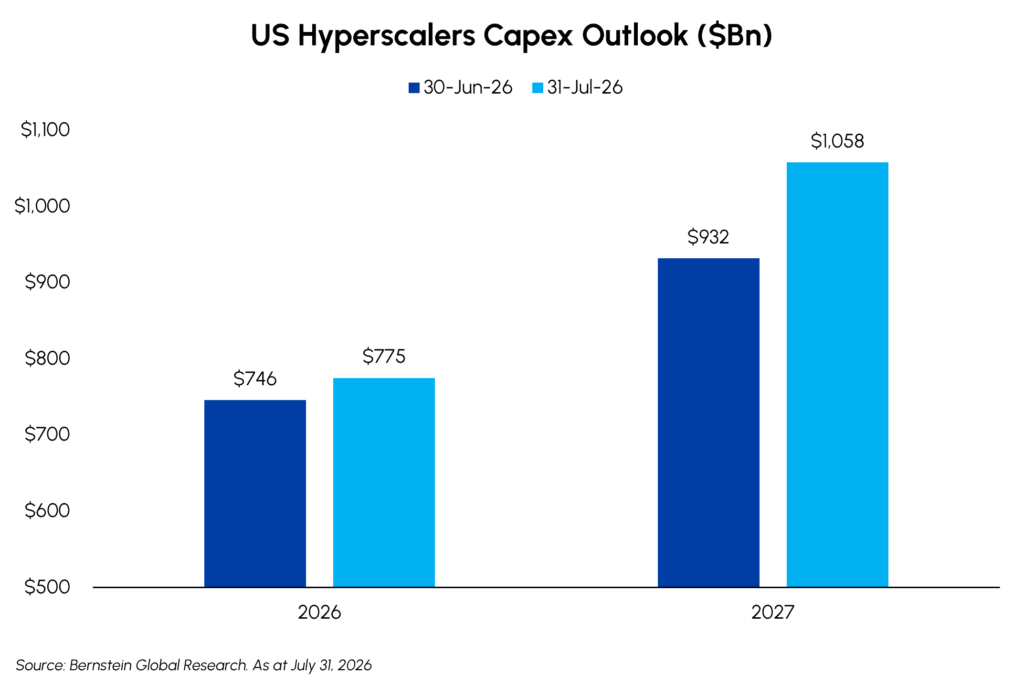
We believe the market is being somewhat shortsighted in punishing the largest capital spenders for the resulting pressure on free cash flow. These companies have deliberately reduced near-term free cash flow margins to fund infrastructure that they expect will support years of future growth. We are not calling for an imminent end to the capital-expenditure cycle. In fact, spending estimates for the group increased once again. However, the current dislocation is unlikely to persist indefinitely. Eventually, the rate of investment will moderate, utilization will rise and the companies making today’s largest investments should begin harvesting substantial amounts of free cash flow.
This environment also highlights why investing in the Magnificent Seven is no longer a simple exercise in owning the entire group. AI has created meaningfully different strategies, capital requirements and value propositions, resulting in much greater stock-level dispersion. We continue to favour Amazon and Microsoft. Both occupy what we would describe as a relatively neutral position within the AI ecosystem, serving as critical “middleware” between model providers and end users. Their advantage is not dependent on winning the race to build the single most powerful model. Instead, their cloud platforms, software products and distribution ecosystems can offer customers whichever models best suit their needs. That flexibility should allow them to benefit from AI adoption regardless of which model provider ultimately leads.
Finally, the recent momentum-driven selloff reinforced the importance of separating price action from fundamentals. While some investors reduced technology exposure during the drawdown, we used the volatility to add selectively to cloud and AI infrastructure holdings. Volatility always hurts in the moment, but it creates attractive opportunities when stocks decline for mechanical reasons while earnings expectations continue to improve. In those situations, lower prices do not necessarily signal a weaker investment case – they can represent a more compelling entry point.
Resources
Middlefield Fund Tickers & Codes: MID 800 / MID 161 / MID 265 / MRF FT LP / Discovery FT LP
by Dennis da Silva, Senior Portfolio Manager
Gold traded in a narrow band through July as investors assess the durability of an Iran ceasefire and its implications for monetary policy and the U.S. dollar. Gold equities underperformed broad North American markets in July, for the fifth consecutive month, despite the metal being up slightly 0.8% versus the 3.6% decline of the S&P/TSX Gold Index. July’s price action reinforced that the sector remains highly sensitive to real rates, the dollar, and geopolitical headlines, but it also showed that buyers are still defending the US$4,000/oz level. Our fundamental view of higher gold prices remains supported by central-bank buying, reserve diversification, elevated government debt, and persistent geopolitical uncertainty. We are in the middle of a slow systematic process of gold adoption where central banks have been adding gold reserves for years and governments have grown uncomfortable with the political risk embedded in foreign currency holdings. Discussions have surfaced around gold-backed sovereign debt, where tokenization is making physical ownership practical inside a digital financial system.
Gold equities expressed more volatility than bullion reflecting margin concerns, sentiment fatigue, and the market’s tendency to discount miners more aggressively when gold is choppy. Equity valuations continue to screen attractive, with senior producers currently trading at a 10-20% discount to five-year average cashflow multiples. Cash flow generation remains robust, supporting continued M&A activity as producers look to replenish reserves following a decade of underinvestment in exploration.
July was a month of extreme volatility in global oil and gas markets, as an early de-escalation in the U.S.-Iran conflict gave way to renewed hostilities that drove crude to its biggest monthly gain since March, while fundamentals for North American natural gas remained balanced. The S&P/TSX Capped Energy Index was up an impressive 16.4% in July driven by a 21.8% increase in crude oil while U.S. natural gas declined by 16.1% due to record production and ample storage. European natural gas prices climbed over 40% during July, reaching a four-month high amid lagging storage injection rates and continued disruption to Middle East LNG supply. The Asian natural gas benchmark rose roughly 25% over the same period as buyers competed for scarce cargoes. In sharp contrast to the international squeeze. For investors, this environment continues to favor North American producers and LNG exporters with direct pipeline-to-export exposure, who are best positioned to capture premium international pricing while enjoying comparatively low and stable domestic feedstock costs. We remain bullish on energy, citing extremely tight global inventories, resilient demand, disciplined producer behavior, and energy stocks offering double-digit free cash flow yields.
Exchange Traded Funds (ETFs)
Mutual Funds (FE | F)
TSX-Listed Closed-End Funds
| Fund | Ticker | Strategy |
|---|---|---|
| MINT Income Fund | MID.UN | Equity Income |
| Sustainable Innovation & Health Dividend Fund | SIH.UN | Innovation & Healthcare |
TSX-Listed Split Share Corps. (Class A | Preferred)
| Fund | Ticker | Strategy |
|---|---|---|
| E-Split Corp. | ENS | ENS.PR.A | Energy Infrastructure |
| Real Estate Split Corp. | RS | RS.PR.A | Real Estate |
| Infrastructure Dividend Split Corp. | IS | IS.PR.A | Infrastructure |
LSE-Listed Fund
| Fund | Ticker | Strategy |
|---|---|---|
| Middlefield Canadian Enhanced Income UCITS ETF | LSE: MCTC | LSE: MCTP | Canadian Equity Income |
Commissions, trailing commissions, management fees and expenses all may be associated with mutual fund investments, including ETFs. Please read the prospectus before investing. You will usually pay brokerage fees to your dealer if you purchase or sell units/shares of investment funds on the Toronto Stock Exchange or other alternative Canadian trading system (an “Exchange”). If the units/shares are purchased or sold on an Exchange, investors may pay more than the current net asset value when buying and may receive less than the current net asset value when selling them. There are ongoing fees and expenses associated with owning units or shares of an investment fund. An investment fund must prepare disclosure documents that contain key information about the fund. You can find more detailed information about the fund in these documents. Mutual funds and investment funds are not guaranteed, their values change frequently and past performance may not be repeated. Certain statements in this disclosure are forward-looking. Forward-looking statements (“FLS”) are statements that are predictive in nature, depend upon or refer to future events or conditions, or that include words such as “may”, “will”, “should”, “could”, “expect”, “anticipate”, “intend”, “plan”, “believe”, or “estimate”, or other similar expressions. Statements that look forward in time or include anything other than historical information are subject to risks and uncertainties, and actual results, actions or events could differ materially from those set forth in the FLS. FLS are not guarantees of future performance and are by their nature based on numerous assumptions. Although the FLS contained herein are based upon what Middlefield Funds and the portfolio manager believe to be reasonable assumptions, neither Middlefield Funds nor the portfolio manager can assure that actual results will be consistent with these FLS. The reader is cautioned to consider the FLS carefully and not to place undue reliance on FLS. Unless required by applicable law, it is not undertaken, and specifically disclaimed that there is any intention or obligation to update or revise FLS, whether as a result of new information, future events or otherwise.
This material has been prepared for informational purposes only without regard to any particular user’s investment objectives or financial situation. This communication constitutes neither a recommendation to enter into a particular transaction nor a representation that any product described herein is suitable or appropriate for you. Investment decisions should be made with guidance from a qualified professional. The opinions contained in this report are solely those of Middlefield Limited (“ML”) and are subject to change without notice. ML makes every effort to ensure that the information has been derived from sources believed to reliable, but we cannot represent that they are complete or accurate. However, ML assumes no responsibility for any losses or damages, whether direct or indirect which arise from the use of this information. ML is under no obligation to update the information contained herein. This document is not to be construed as a solicitation, recommendation or offer to buy or sell any security, financial product or instrument.