
Index
Macro Update
by Dean Orrico, President & CEO and Robert Lauzon, CIO
As the leaves begin to turn and the puck drops on a new NHL season, autumn comes with a quiet reminder that colder days lie ahead. Markets have delivered exceptional returns through the first three quarters, yet the tone has shifted noticeably as we enter the fourth. Alongside shorter days and cooler temperatures, a degree of risk aversion has begun to surface, with higher rates, firmer oil prices, and emerging caution in credit supporting a more selective approach. While the fundamental backdrop has not necessarily changed, markets now sit in a delicate balance as we await the full return of earnings season.
Last month, we wrote about our expectation of a choppy consolidation during a seasonally weak September, and the month lived up to that call. Following the Federal Reserve’s unanimous 25-basis-point rate hike on September 16th, the US 10-year Treasury yield has surged by more than 50 basis points as bond markets price in an additional 75 basis points of tightening over the coming year. WTI oil spiked $15/barrel mid-month to $105 before settling back to $90, essentially flat for September. Despite these crosscurrents and associated volatility, global equities proved resilient: the S&P 500 lost just 0.45%, the MSCI World Index dropped 1.3%, and the S&P/TSX fell 2.9%. Year-to-date, all three indices remain up between 12% and 13%.
The equity market was underpinned by robust earnings, and the US economy remains on solid footing with a low, stable unemployment rate and healthy consumer spending supported by wealth creation. While higher rates are generally a headwind for risk assets, we expect a more measured rate cycle than we saw in 2022. We do not anticipate a stagflationary scenario: economic growth is healthy and some of the factors behind more entrenched inflation, especially higher oil prices, look more transient than structural. Inflationary pressure should abate as the Middle East stabilizes and oil again flows through pipelines and the Strait of Hormuz. Over the longer term, AI-driven productivity gains are also expected to be disinflationary. We acknowledge that newsflow heading into the US midterm election on November 3rd could bring more whipsaw across sectors, but the election’s conclusion should itself act as a catalyst once that uncertainty is resolved. The latest poll forecasts a gridlock in the House and the Senate which is bullish for the market. Reinforcing our constructive outlook for equities through year-end and 2027, the chart below illustrates that the S&P 500 has gained after every midterm election since 1950, averaging a 15% return over the subsequent 12 months.
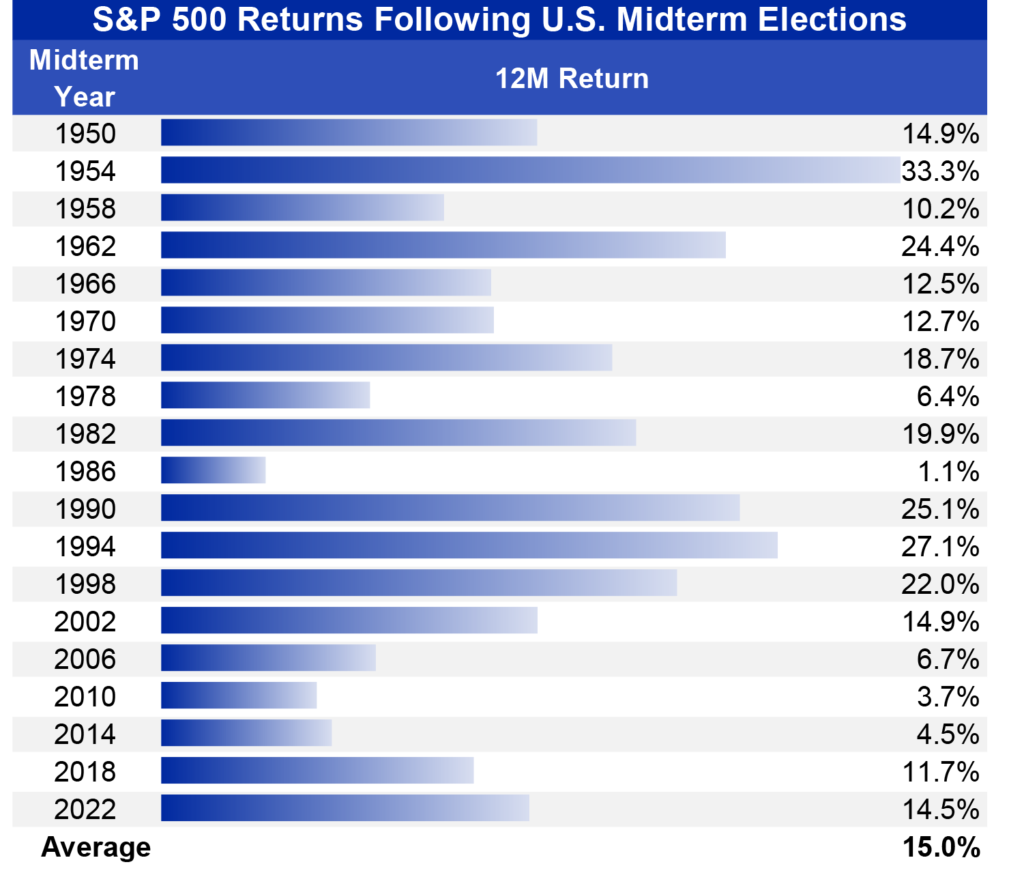
Source: Bank of Montreal Research, as at October 2, 2026
That said, with US 10-year Treasury yields reaching 5.3%, we believe fixed income presents its most attractive opportunity in over two decades. As illustrated in the chart below, the US 10-year Treasury yield decoupled from equity earnings yields and drifted toward historic lows following the dot-com crash of the early 2000s, sustained by prolonged monetary accommodation. That trend reversed sharply post-COVID as central banks raised policy rates to curb entrenched inflation, bringing bond yields back into parity with equity earnings yields. Against a backdrop of diverging global economies, an actively managed global fixed income strategy is uniquely positioned to capture mispriced sovereign debt and high-quality credit opportunities across jurisdictions. Ultimately, a balanced allocation across equities and fixed income provides investors with attractive risk-adjusted returns alongside reliable liquidity.
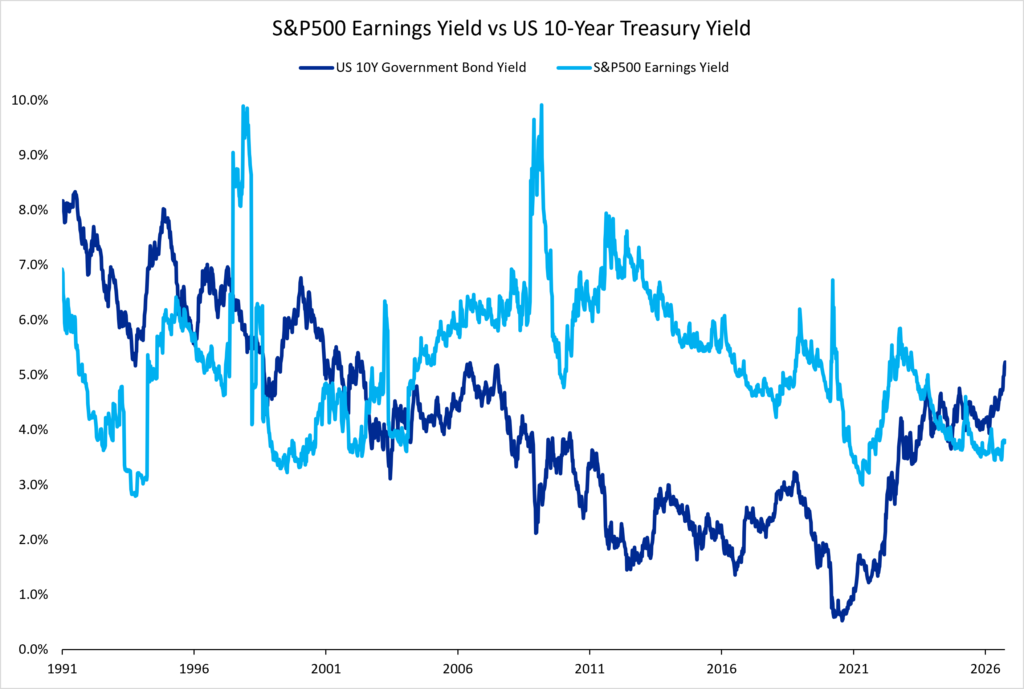
Source: Bloomberg, as at September 30, 2026
Equity performance diverged noticeably in the third quarter. Information Technology (+7%) and Communication Services (+3.5%) posted standout returns, fueled by momentum in artificial intelligence, while Healthcare delivered a solid 6% advance. As AI begins to meaningfully accelerate drug discovery, we believe Healthcare offers compelling value, with strong secular tailwinds that have yet to be fully priced in by the market.
In conjunction with the Canada Investment Summit held in September, the Canadian government under Prime Minister Mark Carney rolled out several major economic initiatives and structural reforms designed to catalyze over $1 trillion in new business investment. The government introduced a permanent Productivity Mega Deduction tax incentive, allowing businesses to immediately deduct 100% of the cost of a broad range of capital investments. The federal government will also seek private investment through long-term concessions to operate Canada’s four largest airports: Toronto Pearson, Vancouver, Montréal-Trudeau, and Calgary. To accelerate economic capacity, the government introduced major regulatory reforms, including Bill C-39, the Building Canada Strong Act, aimed at bringing greater speed, certainty, and predictability to infrastructure project reviews and supporting the workers who will build them. We believe these initiatives should provide a meaningful tailwind for the Canadian economy and equity market.
Real Estate
Middlefield Fund Tickers & Codes: MREL / MID 600 / RS / RS.PR.A
by Dean Orrico, President & CEO
The S&P/TSX Capped REIT Index posted a -2.2% total return for the month. While the Middlefield Real Estate Dividend fund trailed the benchmark in the month, it’s 6.2% total return on a YTD basis is outperforming by more than 1.2% in 2026. The US Federal Reserve raised interest rates by 25 bps in September, and the Bank of Canada may also consider a rate hike soon. While higher rates are generally negative for the real estate sector, we expect the rate cycle to be relatively shallow, with the US ten-year bond remaining range-bound and 5.5% as the upper end. Notwithstanding the YTD escalation in ten-year yields by 55 bps and 112 bps in Canada and the US, respectively, our real estate portfolios have held up well, especially relative to other “interest-sensitive” equity sectors. To this point, the S&P 500 utilities sector and the financials sector have lost 7% and 2% respectively YTD.
The Canadian economy has also held up better than expected. This is reflected in select subsectors and regions where fundamentals are solid and less exposed to interest rates. Specifically, health care providers and services as well as healthcare REITs, which we are overweight, have performed well year-to-date. Core names, including Welltower and Extendicare, are up 29.4% and 37.4%, respectively in 2026, outperforming not only the sector but the broader market. While Residential REITs are under pressure on both sides of the border due to affordability concerns, slower population growth, and oversupply in certain regions (GTA, BC, US Sunbelt), there has been a notable divergence in share performance. For example, Killam Apartment, which has been a long-time core holding, has outperformed Canadian Apartment Properties by more than 20% year-to-date. Killam, with extensive exposure in Halifax — where local economic growth is driven by an increasing in federal defence spending — is well positioned to capture population growth and higher rents over the longer term. We also hold a nearly 3% active position in Flagship Communities REIT, a manufactured housing company benefiting from resilient demand for manufactured homes as traditional housing affordability remains challenging, offering a defensive growth narrative.
Recent M&A and take-out transactions continue to confirm that public REITs are undervalued. In the most recently announced transaction, Slate Grocery is selling its US grocery anchored retail centres to Brixmor and Everview at a share price of US$13 — roughly on par with Slate’s IFRS NAV per share. The deal is expected to close in Q1 2027. While the price appears to exceed analyst expectations, we were disappointed that the distribution was suspended just before the takeover was announced, penalizing minority shareholders. We did not own Slate Grocery in our portfolios.
We are mindful of near-term pressure from higher interest rates over the next few months. We believe active management is more important than ever. We’re confident that our proven methodology of focusing on companies with solid fundamentals, less-levered balance sheets, and moderate financing needs will continue to drive outperformance, especially given the current headwind of rising rates. We hold a more constructive outlook for 2027 as population growth likely turns positive under the new 2027–2029 Immigration Levels Plan. The Canadian government is making great strides on various fronts, including promoting Canada as a destination for global investment, diversifying trade, and providing tax incentives for infrastructure projects, among other measures, which should have a positive impact on the economy.
Healthcare
Middlefield Fund Tickers & Codes: MHCD / MID 325 / SIH.UN
by Dean Orrico, President & CEO and Liam Schillaci, Portfolio Manager
Healthcare performed well amidst a broader market pullback. The Equal Weight S&P 500 peaked on August 13th and has since declined -6.5%, meanwhile the S&P 500 Healthcare held steady at +0.1%.
Performance in September was led by Life Science Tools (+8.0%), followed by Biotechnology (+1.7%). We are overweight both these sub-sectors, which have generated excellent returns over the past year as AI is deployed to accelerate the drug development cycle.
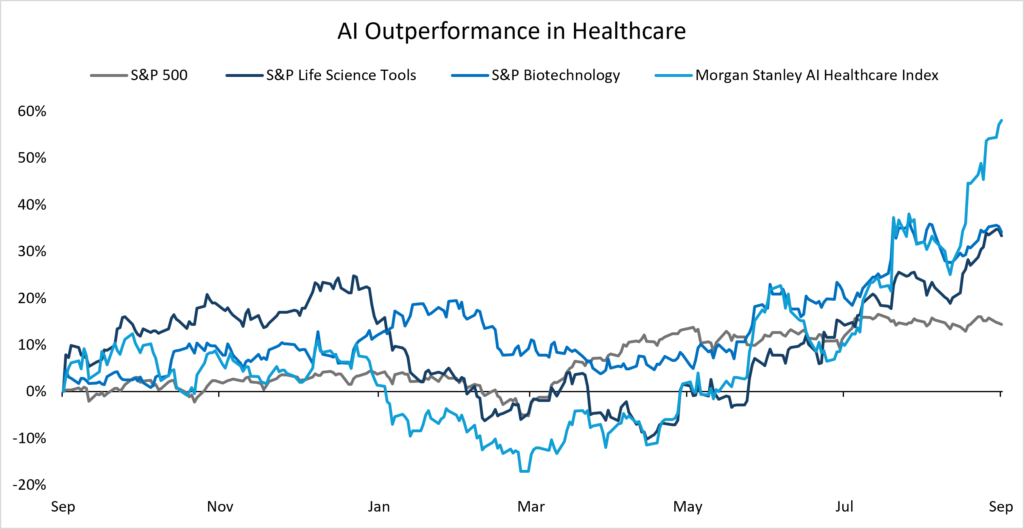
Source: Bloomberg, as of September 30, 2026
We recently met with executives from several portfolio companies at an industry conference. This included a conversation with Natera, which is a leader in using blood-based testing used to measure the presence of cancer tumours. Their test can more accurately determine if a patient is responding to treatment and can detect relapses earlier than traditional imaging techniques. Natera has upside from accelerating adoption and expanding reimbursement from insurers. We also had a productive conversation with Regeneron Pharmaceuticals, which is a leader in immune conditions like eczema and respiratory inflammation. Their flagship injectable is called Dupixent, which has recently received approval for variety of new conditions (namely Asthma and COPD) and is helping millions of patients who were on less effective treatment options. We think our fundamental research process is key to identifying companies with attractive growth opportunities, sustainable competitive advantages, and best-in-class leadership teams.
We think the upcoming midterm elections will be a catalyst for healthcare because the Democrats are poised to take control of the House, and perhaps the Senate. They have been vocal about increasing funding for Medicaid, which is a joint federal and state program to provide health insurance for low-income Americans. We recently added a position in Molina Healthcare, which has direct exposure to Medicaid, but such legislation will also benefit United Health and Humana. Moreover, we think the Democrats will push to increase spending on academic research which would benefit our overweight position in Life Science Tools. Pharmaceuticals could face headline risk because lower drug prices are a bipartisan issue, but much of the industry have already agreed to price concessions and we view any temporary dislocations as an opportunity to add to our highest conviction ideas.
Healthcare continues to offer an attractive combination of defensiveness and secular growth, which is largely uncorrelated with the broader market. Furthermore, the sector is trading near its lowest relative valuation which creates the potential for outsized shareholder returns.
Infrastructure
Middlefield Fund Tickers & Codes: MINF / MID 265 / MID 510 / ENS / IS / IS.PR.A / MID 800
September’s inaugural Canada Investment Summit marked a turning point for Canada’s infrastructure ambitions, shifting the conversation from intent to execution. Through the Major Projects Office, 27 projects now represent $500B of private investment spanning LNG, nuclear, critical minerals, power and data centres. Days after the Summit, Ontario Power Generation awarded $3B in Pickering nuclear refurbishment contracts, including a $1.7B award to the AtkinsRéalis and Aecon joint venture.
The Productivity Mega Deduction (PMD) is the policy that turns this deal flow into cash flow for our holdings. By allowing companies to write off new investments immediately, it rewards those that are paying cash taxes today and reinvesting capital in Canada. Pembina stands out as the best-positioned midstream name, while Keyera and Gibson benefit as they advance expansions. Tourmaline and Whitecap see a direct lift to cash flow on their growth programs while a dedicated deduction for liquefaction equipment strengthens the economic case for new LNG projects. Royalty companies such as Topaz require minimal direct capital expenditures, instead benefiting when operators ramp up drilling activity across their acreage—a dynamic that boosts throughput across Topaz’s royalty and infrastructure assets. Most notably, Pacific Link became the first project designated in the national interest under the Building Canada Act. Once underway, the one-million-barrel-per-day pipeline will serve as a key catalyst for expanding output from oil sands and Clearwater producers. Pembina participates as the sole private-sector partner, while oil sands producers gain improved pricing on their barrels.
Enbridge agreed to acquire Tallgrass Energy’s crude oil business for US$2.55 billion, at an estimated 10-11x forward EBITDA. The centrepiece is a 75% interest in the 460,000 barrel-per-day Pony Express Pipeline, along with storage terminals and a marketing business. The assets complement Enbridge’s existing Express-Platte system, are heavily contracted with investment-grade counterparties, and include an expansion project that lifts capacity to roughly 515,000 barrels per day. Expected to be accretive to distributable cash flow per share in its first full year, the transaction highlights Enbridge’s strategy of acquiring contracted, adjacent assets within its $10–11 billion annual growth capital framework.
Technology & Communications
Middlefield Fund Tickers & Codes: MINN / SIH.UN / MID 925 / MDIV
by Shane Obata, Portfolio Manager
September was a noisy month for markets. Higher bond yields, elevated energy prices and geopolitical uncertainty all created reasons for investors to be cautious, particularly in technology and Asia. Yet underneath that volatility, the fundamental picture continued to improve. Manufacturing data were especially telling: South Korea posted its fastest export growth in more than 15 years, while Taiwan’s factory activity strengthened on continued AI and semiconductor demand. Foreign investors have also started returning to Asian equities after an extended period of selling. For us, that is an important reminder that earnings ultimately matter more than the narrative.
Resonac is a good example of where we continue to see opportunity. The company supplies many of the materials needed to package increasingly large and complex AI chips, including copper-clad laminates used in advanced package substrates. As AI processors get bigger, the substrate underneath them also becomes larger, more complex and more valuable. Resonac’s August results already reflected this strength, as its semiconductor materials division delivered record quarterly revenue and operating profit, prompting management to raise full-year guidance. September provided additional industry confirmation: major substrate suppliers are committing billions of dollars to new capacity, while high-end ABF substrates remain tight because AI chips require significantly more substrate area and more layers than traditional processors.
There is also another AI angle to Resonac that receives less attention: hard-drive media. AI does not just require enormous amounts of computing power; it also creates enormous amounts of data that need to be stored. Toshiba announced this week that it is expanding production of high-capacity hard drives for data centres and aims to nearly double capacity by fiscal 2027 versus fiscal 2025. Resonac is a major independent producer of the magnetic media inside these drives and has a history of working with HDD manufacturers including Toshiba. We therefore see the storage buildout as an additional potential tailwind alongside advanced semiconductor packaging.
Finally, Micron provided perhaps the clearest evidence yet that the AI infrastructure cycle remains durable. Management said demand for memory has strengthened further and expects demand to exceed supply in both 2027 and 2028, with conditions becoming tighter rather than looser. New factories take years to build and even longer to ramp, while increasingly sophisticated AI memory consumes more manufacturing capacity. Micron also now has $32 billion of long-term customer commitments, providing unusually strong visibility for what has historically been a cyclical industry.
For MINN, the message is straightforward: despite a challenging macro backdrop, the earnings evidence across memory, advanced packaging and storage continues to strengthen, particularly in Asia, where we believe our differentiated global research remains an important source of alpha.
Resources
Middlefield Fund Tickers & Codes: MID 800 / MID 161 / MID 265 / MRF FT LP / Discovery FT LP
by Dennis da Silva, Senior Portfolio Manager
Gold equities declined 6.1% in September, underperforming broader North American markets as a stronger U.S. dollar and a ‘higher for longer’ rate backdrop weighed on the group. Investors nonetheless kept adding to gold bullion ETFs, looking past incremental shifts in rate expectations toward the larger structural forces underpinning the metal: deteriorating government finances, persistent inflation, geopolitical uncertainty and evolving global reserve allocations. Operationally, the month was more challenging for several large producers. Kinross cut its 2026-2027 guidance, Gold Fields extended a year-long string of downward revisions, and Shandong Gold lowered its 2026 production target. Between operational misses, reserve depletion and the strategic need for scale, the sector is increasingly turning to acquisitions. With strong balance sheets and the ability to use their shares as currency, senior producers often find it more attractive to buy ounces than to build them organically. We believe this sets up a favourable environment for the junior developers held in Canadian Dividend Growers and our flow-through partnerships.
In energy, WTI crude advanced during September on Middle East supply concerns and a strained global refining system. European and Asian natural gas prices initially climbed to their highest levels since January 2023 on low storage, before retreating in the back half of September as more LNG cargoes moved safely through the Strait of Hormuz, European wind generation improved, and Asian buyers completed much of their near-term winter procurement. U.S. natural gas, by contrast, traded in a narrow range for most of the month, as a well-supplied, inventory-heavy North American market remained largely insulated from geopolitical disruption abroad.
While crude has captured the headlines, refining margins have been the bigger driver of the higher costs that consumers are feeling, from fuel at the pump to the many goods that depend on diesel. These margins, known as crack spreads, measure the difference between the price of crude oil and the gasoline and diesel a refinery produces from each barrel. Crack spreads held near record levels throughout September even as crude prices fluctuated. The IEA characterized the global refining system as “stretched to the limit,” and although the benchmark U.S. crack spread eased modestly from its all-time high on August 31, it remains in the 99th percentile of its 40-year history.
Exchange Traded Funds (ETFs)
Mutual Funds (Series A | F | I | O)
TSX-Listed Closed-End Funds
| Fund | Ticker | Strategy |
|---|---|---|
| MINT Income Fund | MID.UN | Equity Income |
| Sustainable Innovation & Health Dividend Fund | SIH.UN | Innovation & Healthcare |
TSX-Listed Split Share Corps. (Class A | Preferred)
| Fund | Ticker | Strategy |
|---|---|---|
| E-Split Corp. | ENS | ENS.PR.A | Energy Infrastructure |
| Real Estate Split Corp. | RS | RS.PR.A | Real Estate |
| Infrastructure Dividend Split Corp. | IS | IS.PR.A | Infrastructure |
LSE-Listed Fund
| Fund | Ticker | Strategy |
|---|---|---|
| Middlefield Canadian Enhanced Income UCITS ETF | LSE: MCTC | LSE: MCTP | Canadian Equity Income |
Commissions, trailing commissions, management fees and expenses all may be associated with mutual fund investments, including ETFs. Please read the prospectus before investing. You will usually pay brokerage fees to your dealer if you purchase or sell units/shares of investment funds on the Toronto Stock Exchange or other alternative Canadian trading system (an “Exchange”). If the units/shares are purchased or sold on an Exchange, investors may pay more than the current net asset value when buying and may receive less than the current net asset value when selling them. There are ongoing fees and expenses associated with owning units or shares of an investment fund. An investment fund must prepare disclosure documents that contain key information about the fund. You can find more detailed information about the fund in these documents. Mutual funds and investment funds are not guaranteed, their values change frequently and past performance may not be repeated. Certain statements in this disclosure are forward-looking. Forward-looking statements (“FLS”) are statements that are predictive in nature, depend upon or refer to future events or conditions, or that include words such as “may”, “will”, “should”, “could”, “expect”, “anticipate”, “intend”, “plan”, “believe”, or “estimate”, or other similar expressions. Statements that look forward in time or include anything other than historical information are subject to risks and uncertainties, and actual results, actions or events could differ materially from those set forth in the FLS. FLS are not guarantees of future performance and are by their nature based on numerous assumptions. Although the FLS contained herein are based upon what Middlefield Funds and the portfolio manager believe to be reasonable assumptions, neither Middlefield Funds nor the portfolio manager can assure that actual results will be consistent with these FLS. The reader is cautioned to consider the FLS carefully and not to place undue reliance on FLS. Unless required by applicable law, it is not undertaken, and specifically disclaimed that there is any intention or obligation to update or revise FLS, whether as a result of new information, future events or otherwise.
This material has been prepared for informational purposes only without regard to any particular user’s investment objectives or financial situation. This communication constitutes neither a recommendation to enter into a particular transaction nor a representation that any product described herein is suitable or appropriate for you. Investment decisions should be made with guidance from a qualified professional. The opinions contained in this report are solely those of Middlefield Limited (“ML”) and are subject to change without notice. ML makes every effort to ensure that the information has been derived from sources believed to reliable, but we cannot represent that they are complete or accurate. However, ML assumes no responsibility for any losses or damages, whether direct or indirect which arise from the use of this information. ML is under no obligation to update the information contained herein. This document is not to be construed as a solicitation, recommendation or offer to buy or sell any security, financial product or instrument.